Part of ‘Stories of contemporary domesticity or HOMEland’, a series curated by Archt. for Archisearch, exploring different interpretations of the notion of home through an open dialogue with current architectural approaches to housing, the twenty-first episode follows 127af architects as they transform a modest workers’ house, characteristic of the urban fabric of Bagnolet in the eastern suburbs of Paris, through a rooftop extension. The result is LOU—an adaptable domestic ecosystem that evolves with its inhabitants, accommodating both present and future needs while redefining their relationship with light, air, and everyday life.
A suburb of productive domesticity
Bagnolet is one of the most fascinating—yet often overlooked—territories of the Parisian banlieue. Although its contemporary image is largely associated with the postwar urban transformations of the 1960s and 1970s—large housing estates, infrastructural megaprojects, and the metropolitan threshold created by the Boulevard Périphérique and the A3 motorway—its deeper architectural identity lies in a far more modest and intimate fabric: the workers’ houses, narrow plots, and self-built dwellings that emerged as the former rural village gradually transformed into an industrial suburb of Paris.
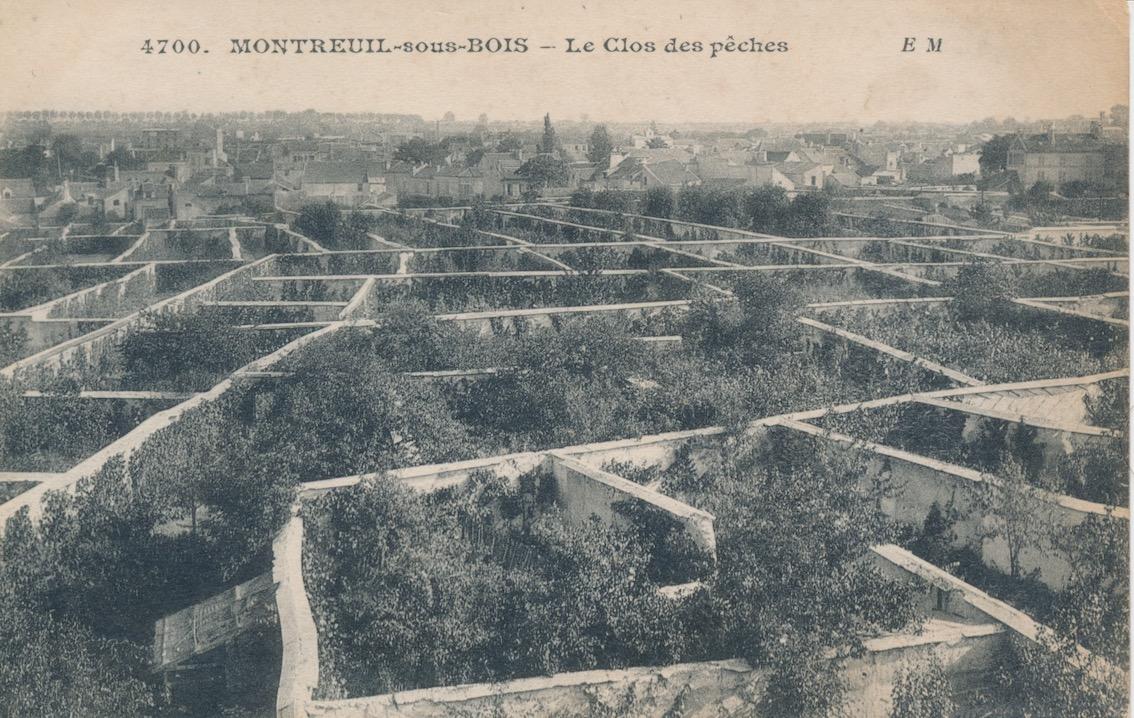
From the seventeenth century until the middle of the nineteenth, Bagnolet was primarily an agricultural landscape. Orchards, vineyards, market gardens, and, most famously, the clos à pêches—walled peach gardens enclosed by high plastered walls—defined its territory. These walls captured the warmth of the sun during the day and slowly released it during the night, creating a microclimate that allowed delicate peach varieties to flourish in the cooler environment of the Île-de-France. At their peak, these productive gardens covered hundreds of hectares and established Bagnolet as one of Paris’ most significant horticultural landscapes.
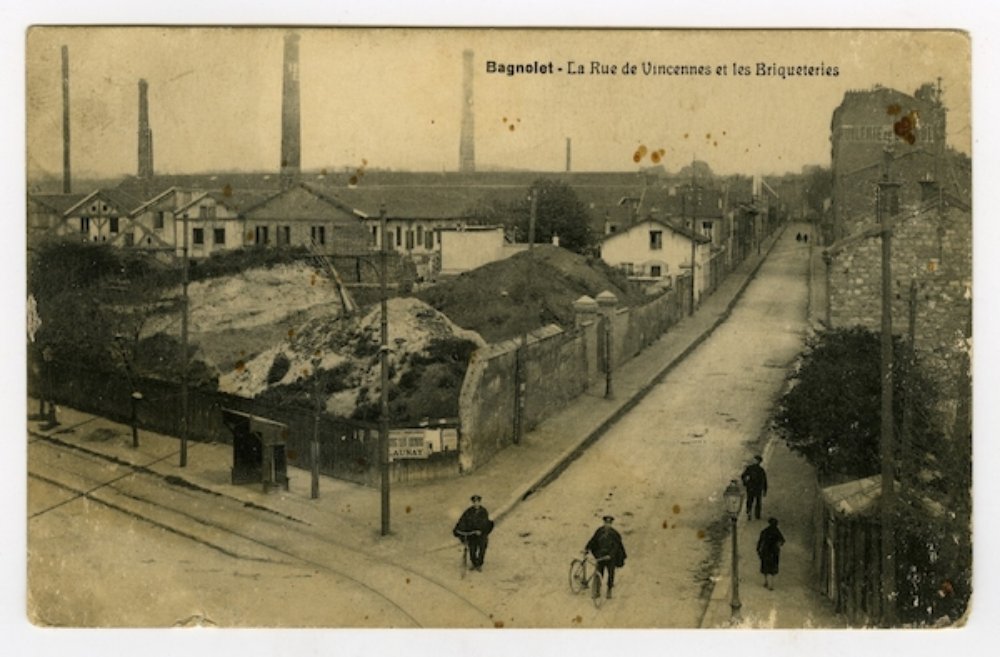
The expansion of Paris under Baron Haussmann and the rapid industrialisation of the eastern districts transformed this rural territory into a workers’ suburb.
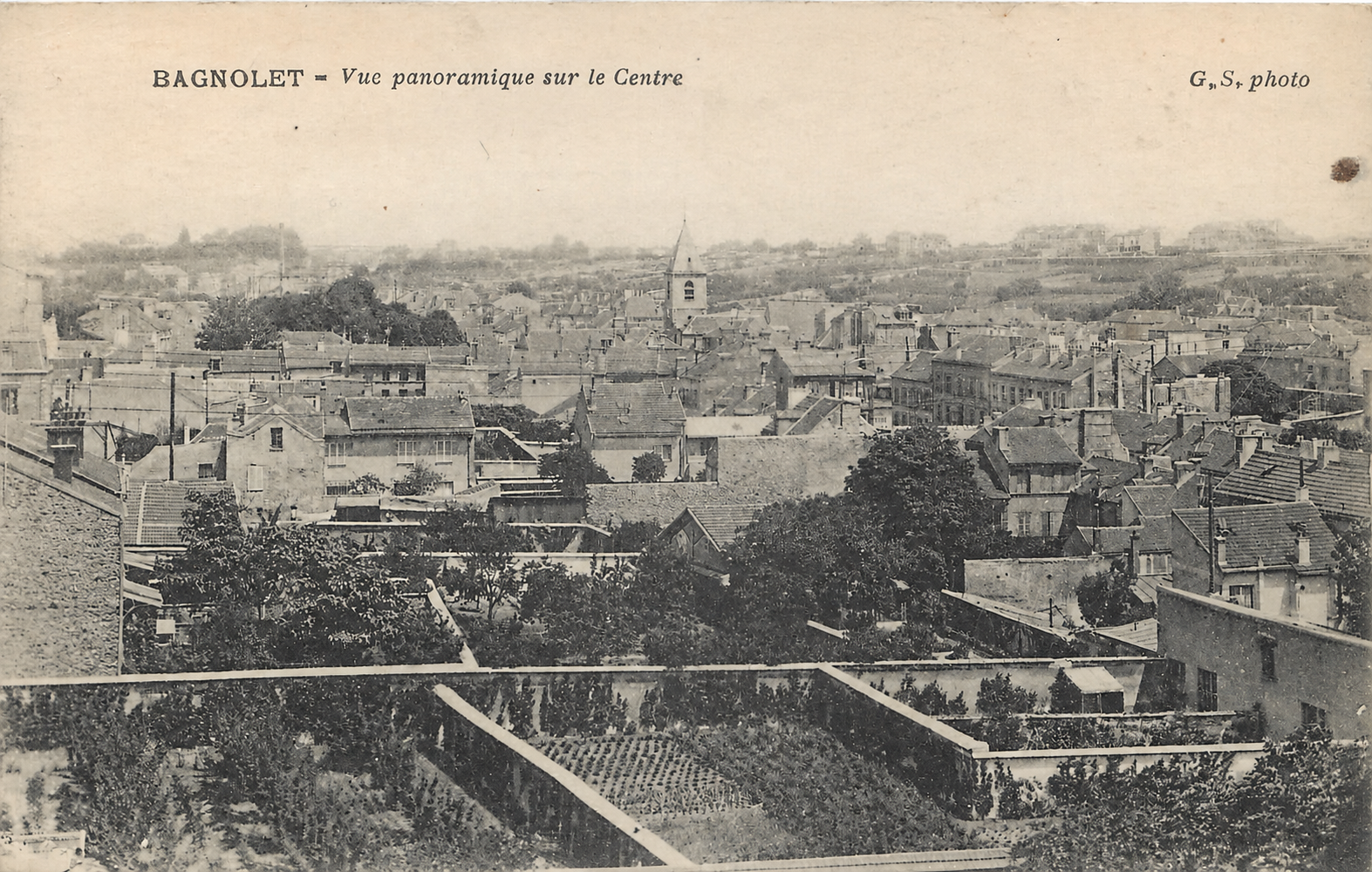
Between the late nineteenth and early twentieth centuries, artisans, labourers, and small manufacturers migrated beyond the city’s boundaries in search of affordable land and the possibility of constructing their own homes. A heterogeneous urban condition emerged: neither village nor metropolis, neither agricultural territory nor fully industrial city.
It was a landscape of transition, composed of workshops, gardens, storage yards, and modest houses where domestic and productive life coexisted within the same parcel.
This condition corresponds to what urban historians describe as the faubourg—a peripheral territory shaped less by grand urban planning than by incremental growth and everyday practices (Choay, 1965). The city was built not through singular architectural gestures but through the slow accumulation of ordinary constructions, adaptations, and extensions.
The pavillonnaire landscape: living and working under the same roof
Much of Bagnolet developed through lotissements—small subdivision operations—rather than comprehensive planning. The Chassagnole subdivision, established at the end of the nineteenth century, exemplifies this process: agricultural land was divided into narrow plots and gradually occupied by middle- and working-class families.
The result was the formation of a dense tissu pavillonnaire: a suburban fabric composed of small detached or semi-detached houses surrounded by gardens, courtyards, and productive spaces.
Unlike the bourgeois villa suburbs developed in the western outskirts of Paris, Bagnolet’s houses were fundamentally hybrid. The worker’s dwelling was often simultaneously a home, a workshop, a storage space, a small business, or a place of informal production. The separation between dwelling and labour—the modernist principle of zoning that would dominate twentieth-century planning—had not yet occurred.
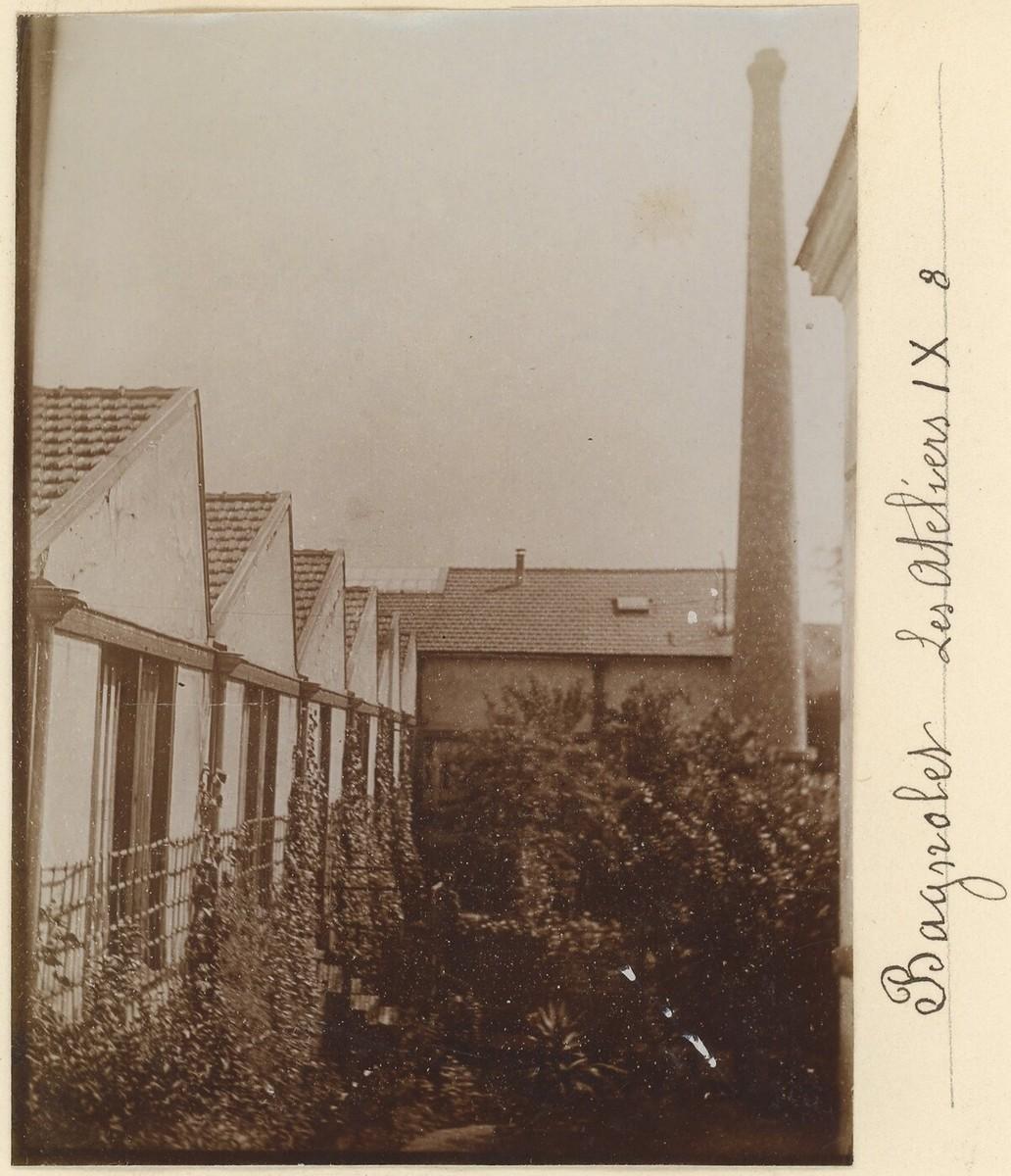
In this sense, these ordinary houses anticipated what contemporary architects increasingly recognise as the value of adaptable and mixed-use environments.
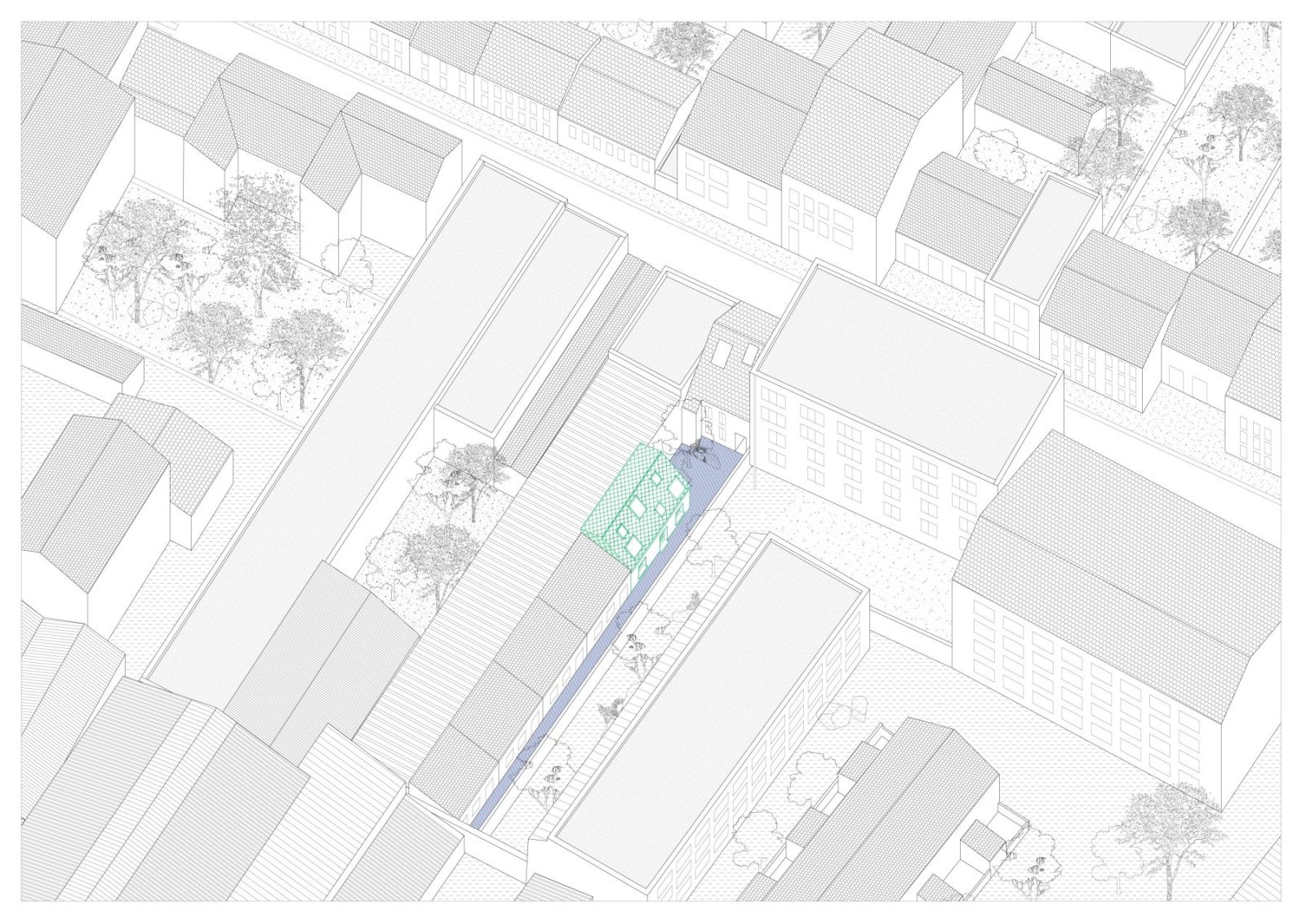
Their architectural significance lies precisely in their incompleteness: they were conceived not as fixed objects but as frameworks capable of transformation over time, echoing John Habraken’s later theories of open building and the capacity of inhabitants to shape their own domestic environment (Habraken, 1972).
The worker’s house as an architecture of adaptation
Rarely designed by architects, the traditional Bagnolet worker’s house followed a simple yet resilient typology. One or two storeys in height, it occupied narrow and deep parcels and was constructed using ordinary materials—brick, rendered masonry, or rubble stone. A small courtyard, garden, workshop, or storage space frequently extended the domestic realm beyond the walls of the house.
Its architectural value resided in adaptability. Built incrementally by owners, craftsmen, and local contractors, these houses absorbed the changing needs of their inhabitants through additions, modifications, and informal transformations.
As Bernard Rudofsky famously argued in Architecture Without Architects (1964), the intelligence of anonymous architecture often lies in its ability to evolve through necessity rather than formal ambition.
The birth of LOU: an architecture of care
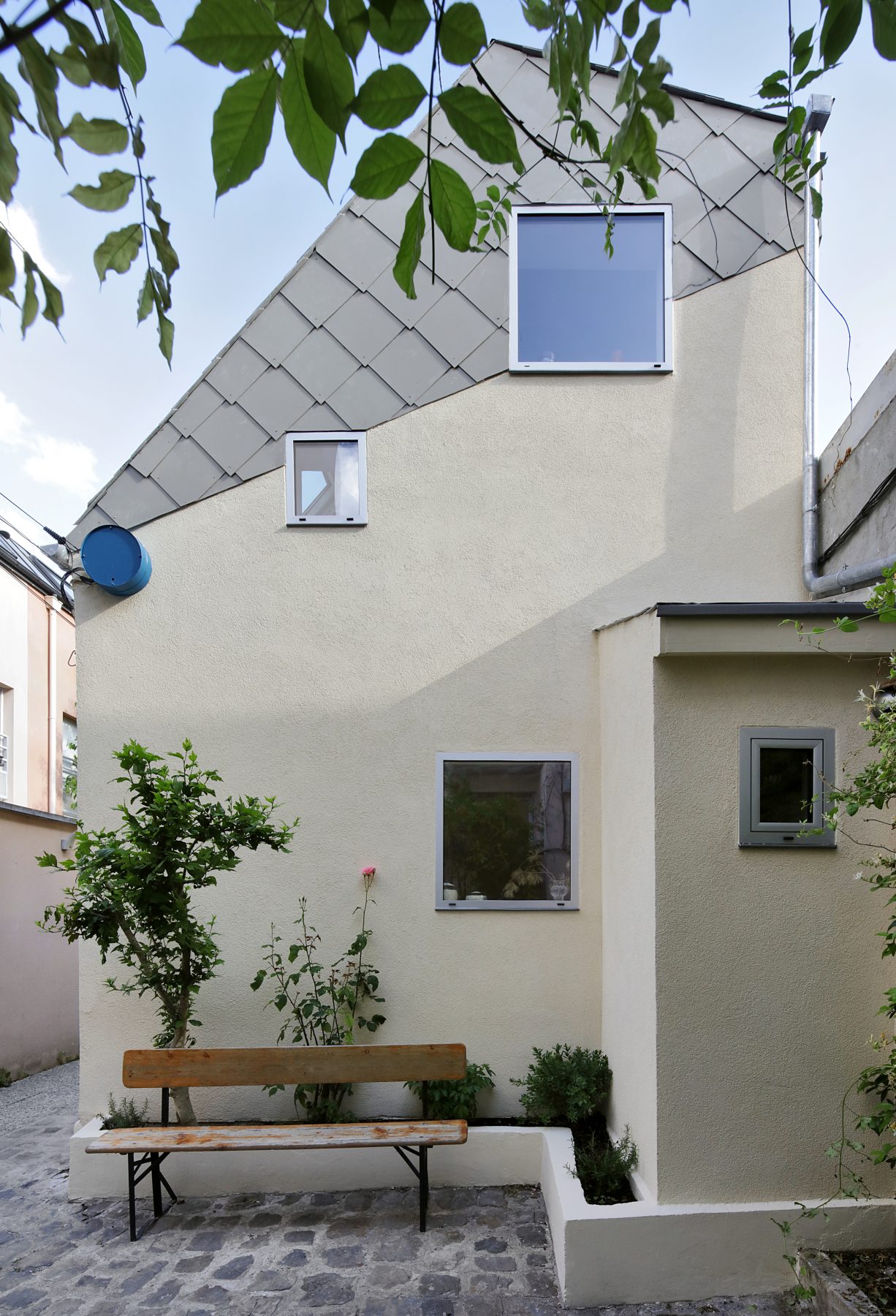
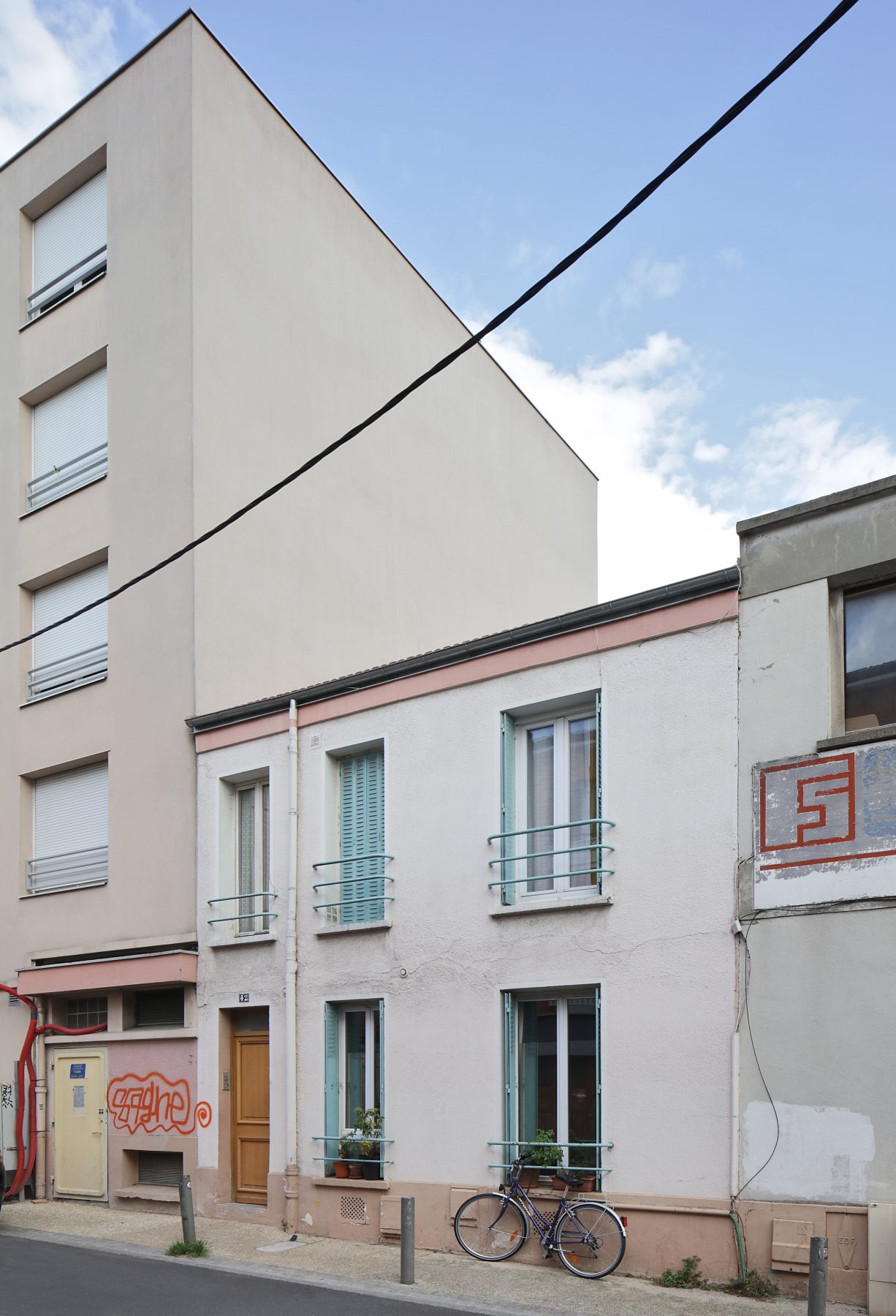
It is precisely these values of adaptability, modesty, and gradual transformation that 127af reinterprets in LOU, the renovation and extension of a typical worker’s house located within a row of four terraced dwellings in Bagnolet.
The project originated from a simple domestic event: the birth of the family’s second child and the need to transform the existing attic into an inhabitable space.
Rather than imposing a radical intervention, the architects approached the house as a delicate act of repair—an operation closer to embroidery than reconstruction.
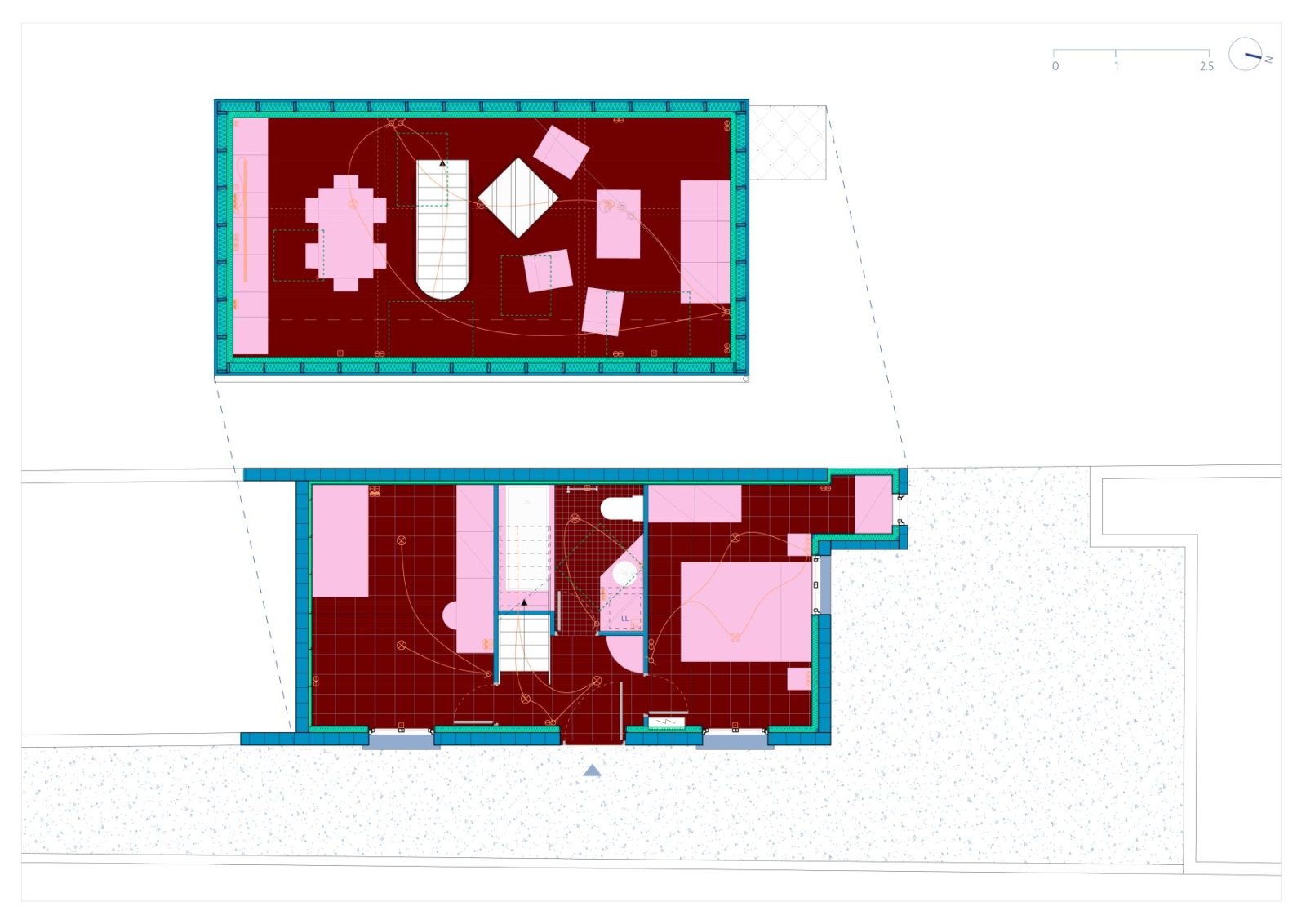
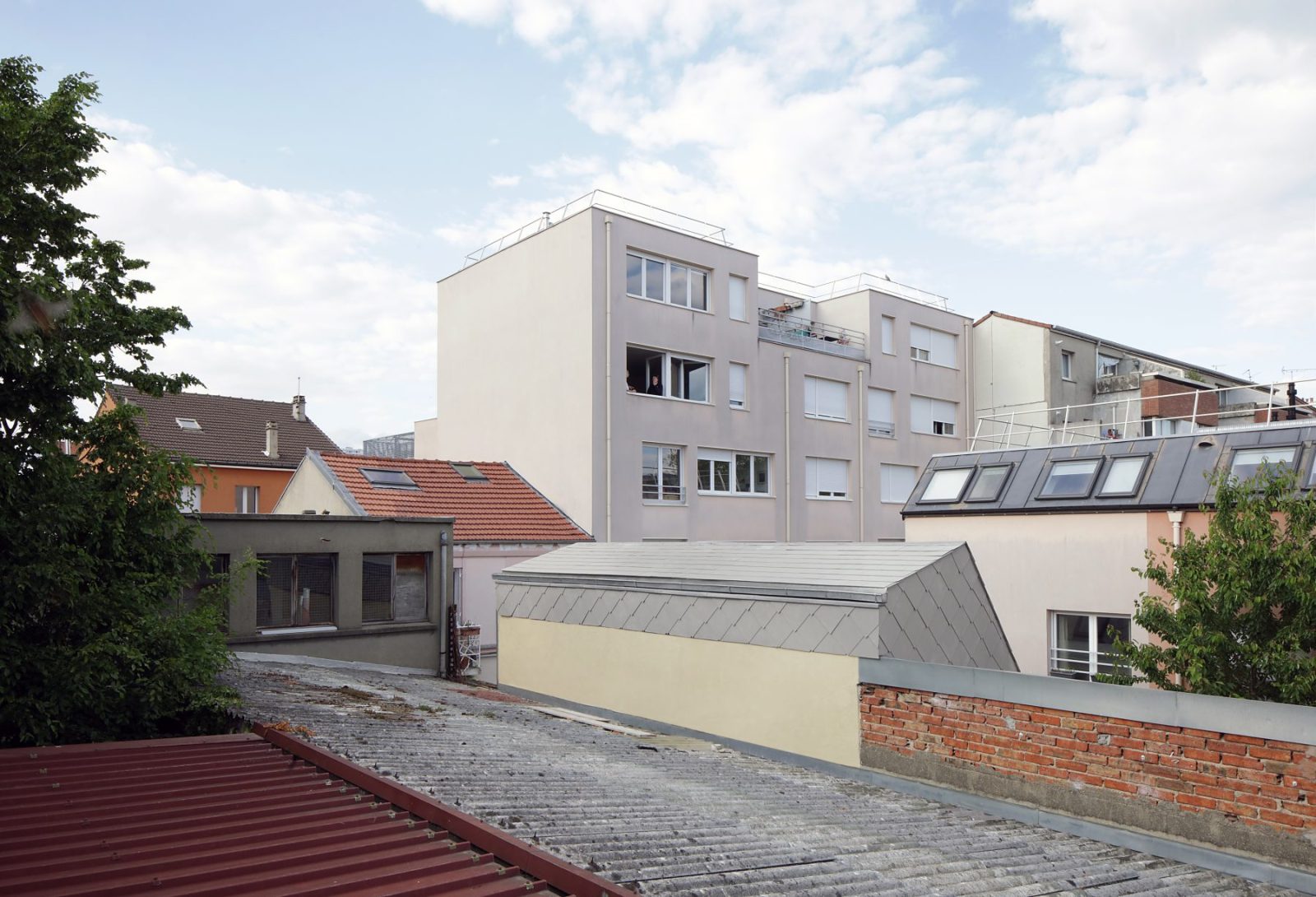
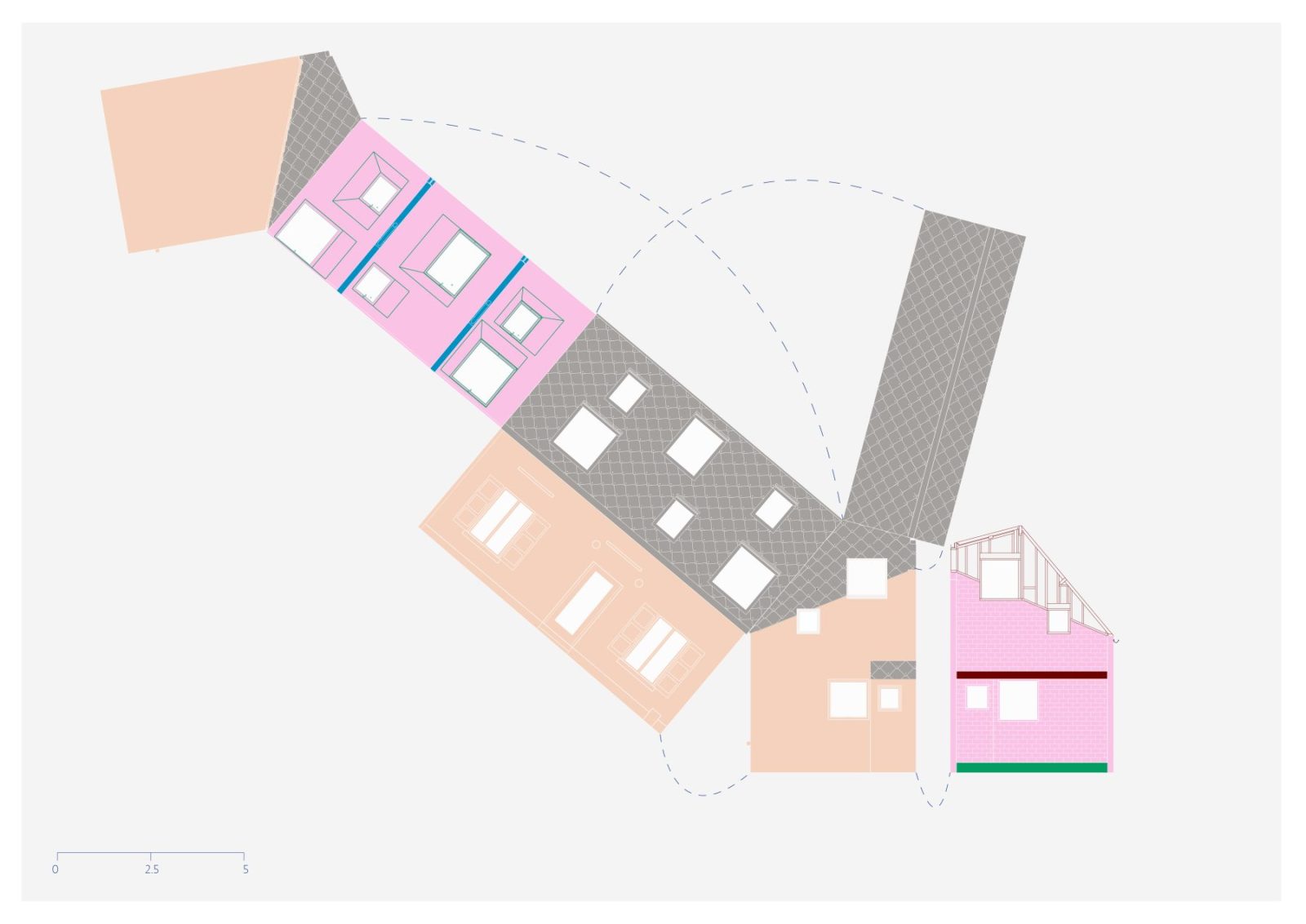
Working with a limited budget, the project confronted multiple constraints: the interlocking geometry of the narrow plots, the existing organisation consisting of a single living space on the ground floor and low-ceilinged bedrooms and bathroom under the eaves, the need to preserve neighbouring privacy, and the obligation to maintain sunlight access despite altering the roof volume.
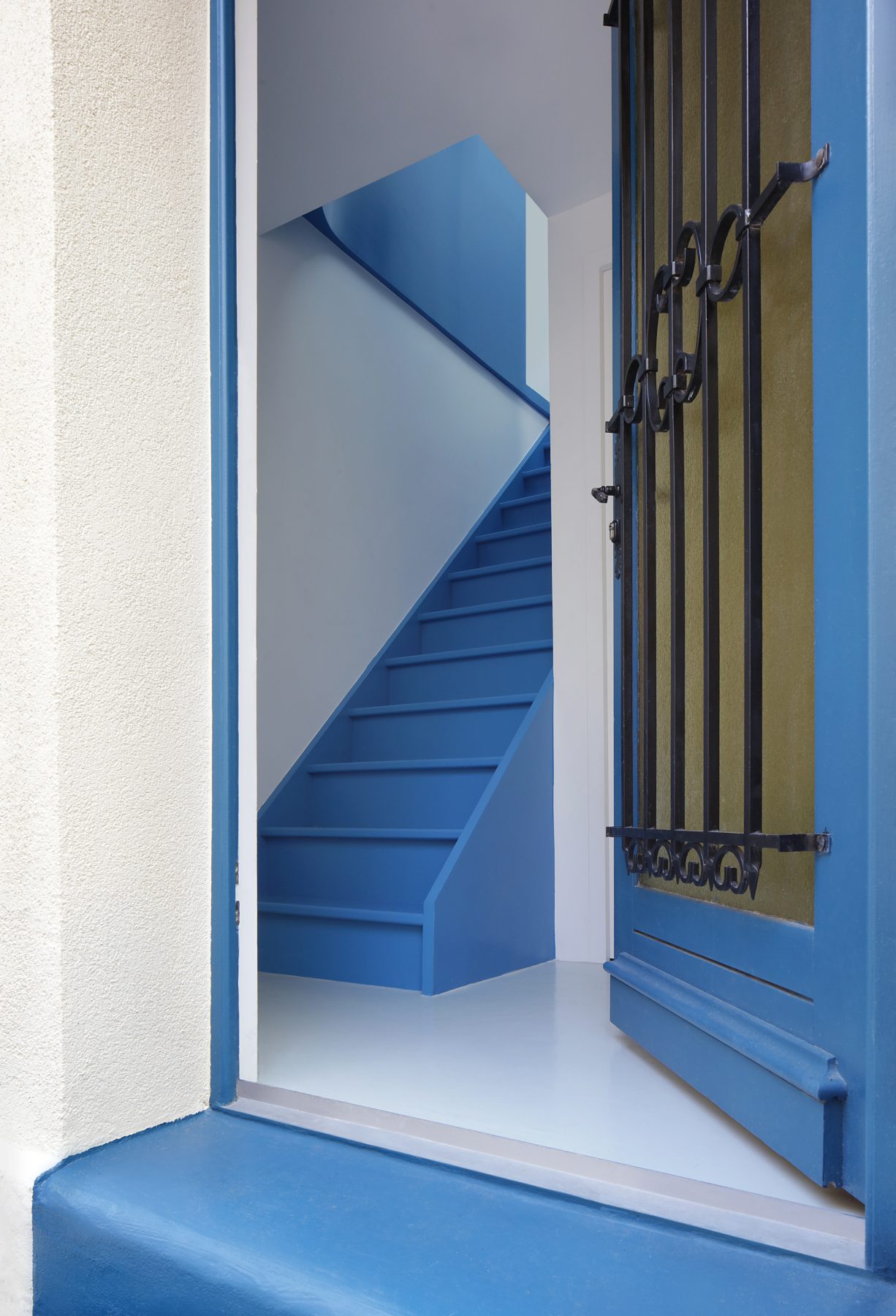
“Access, located through the rear courtyard of a street-front building, was limited to a single door and a narrow corridor,” say the architects.
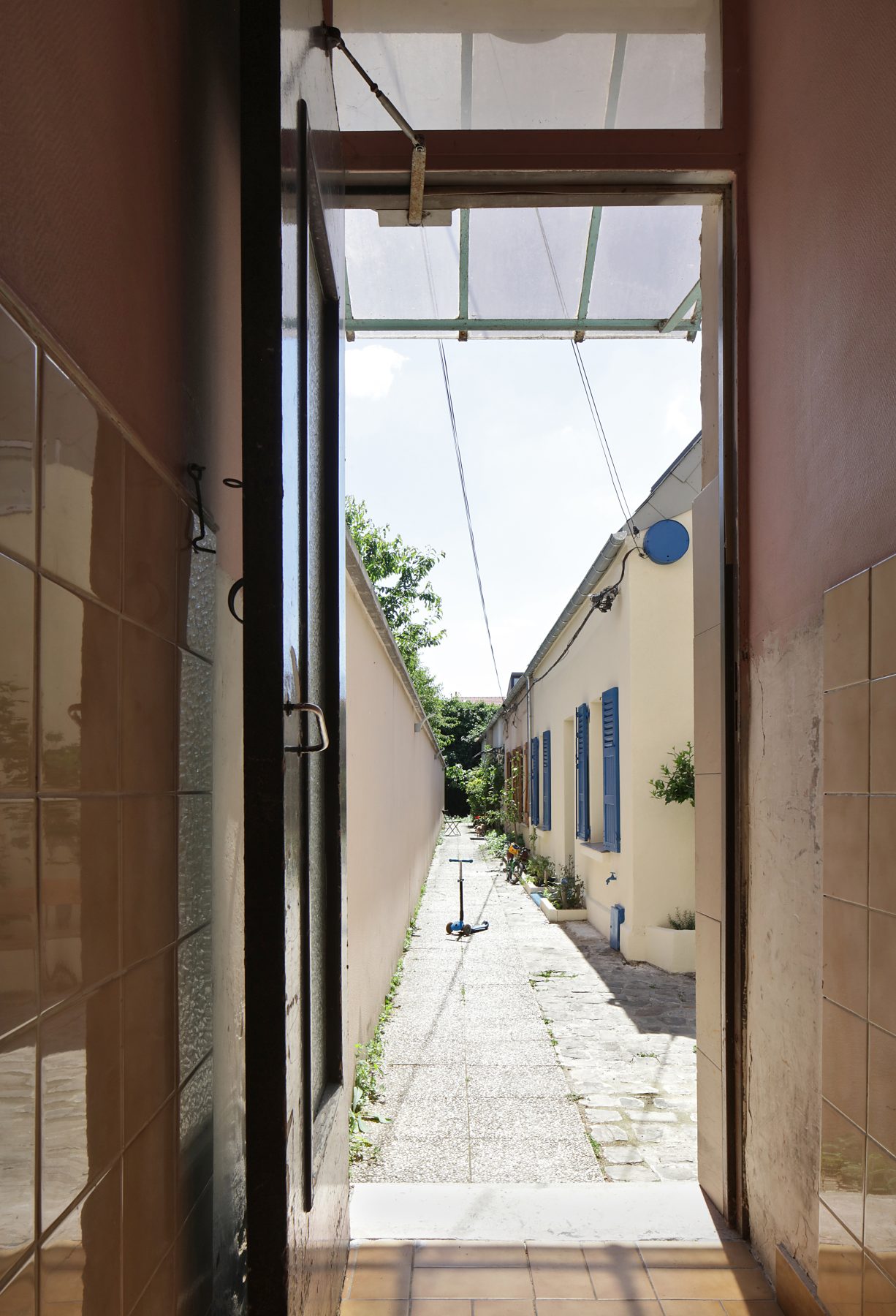
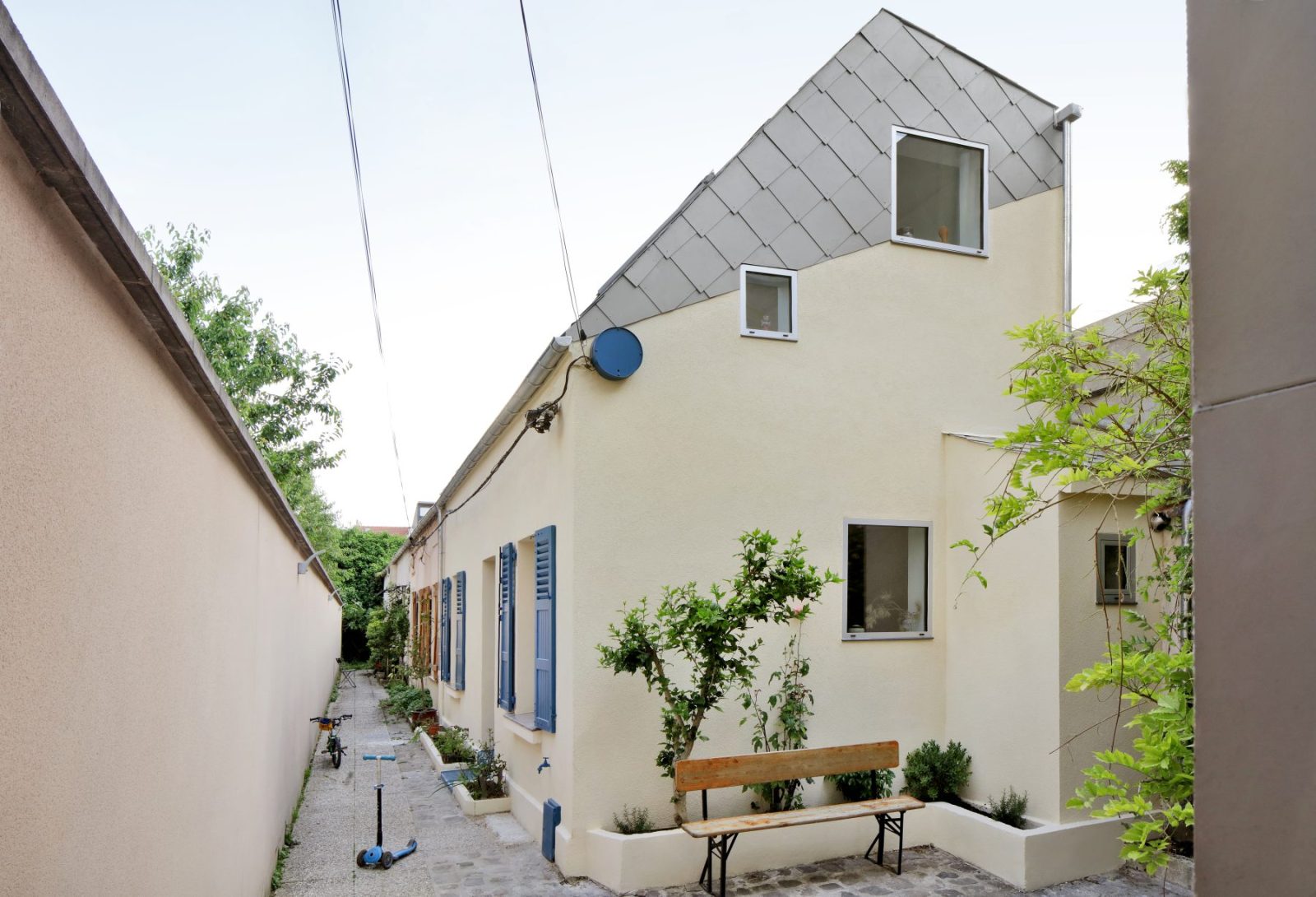
Through a process of close dialogue with the family, neighbours, and local authorities, the architects developed a strategy of spatial inversion. The private realm—bedrooms and bathroom—remains anchored on the cooler ground floor, while the collective spaces of daily life rise into a new roof volume immersed in light and air. The lower level, illuminated by modest openings facing the party wall, benefits from the thermal stability of the existing masonry and naturally maintains a cooler atmosphere during the summer months.
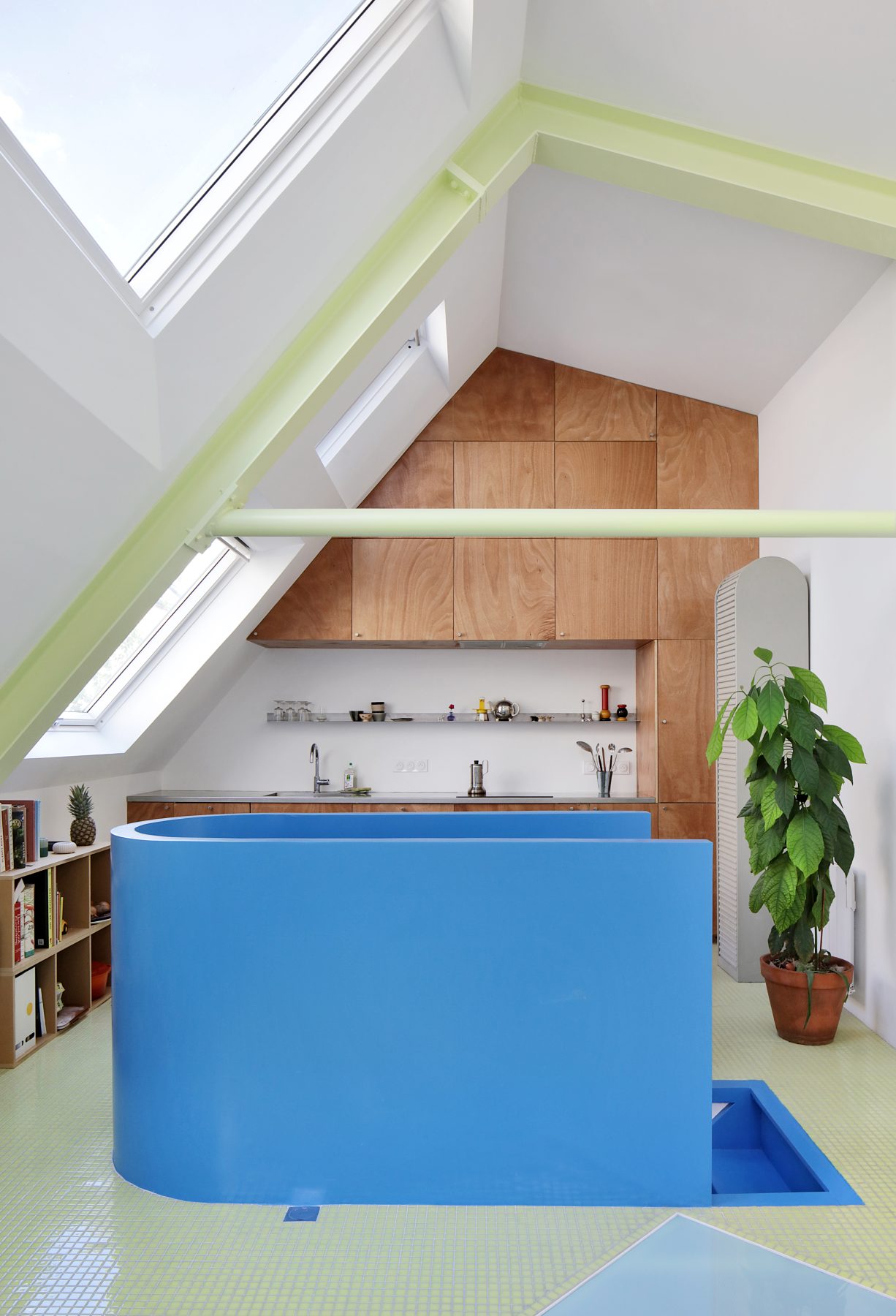
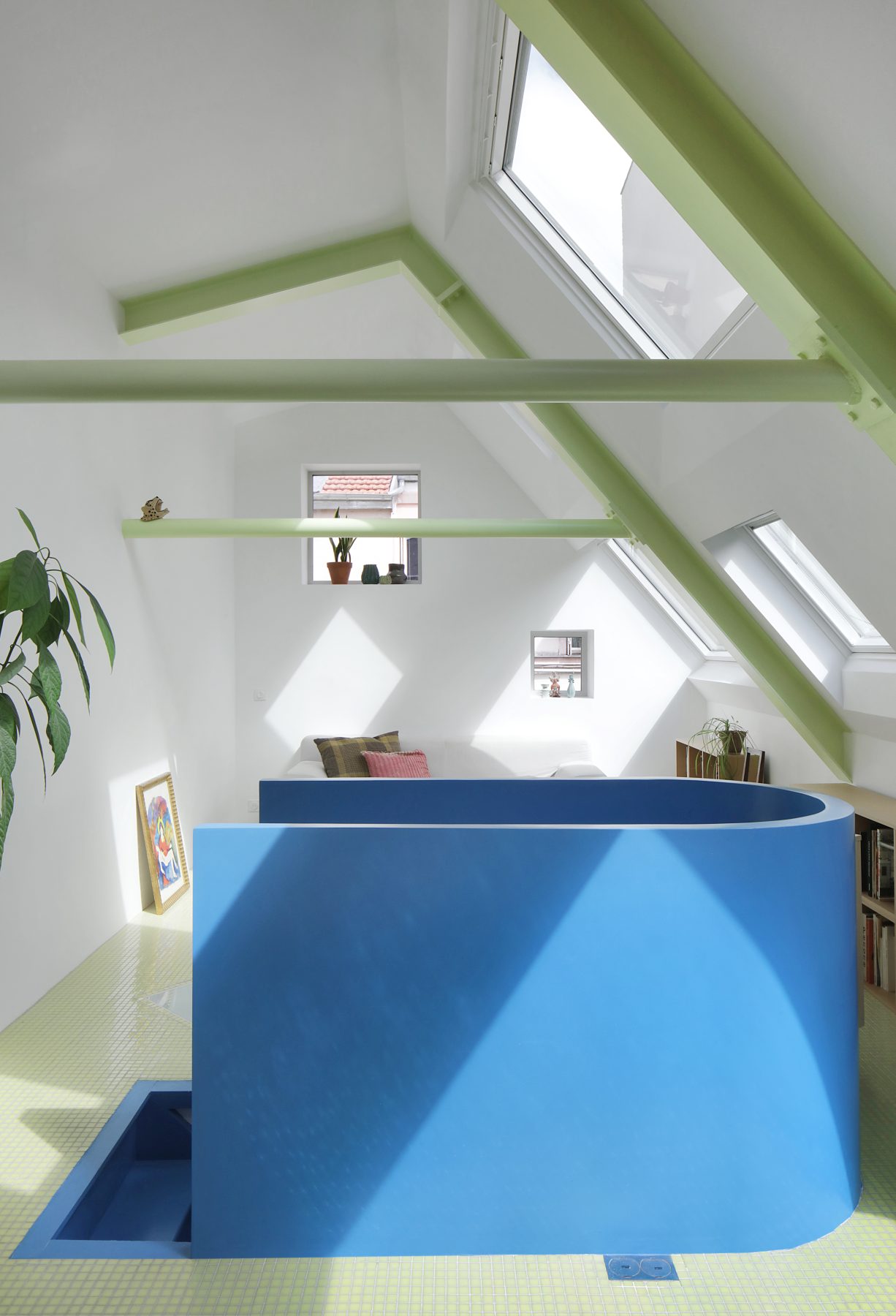
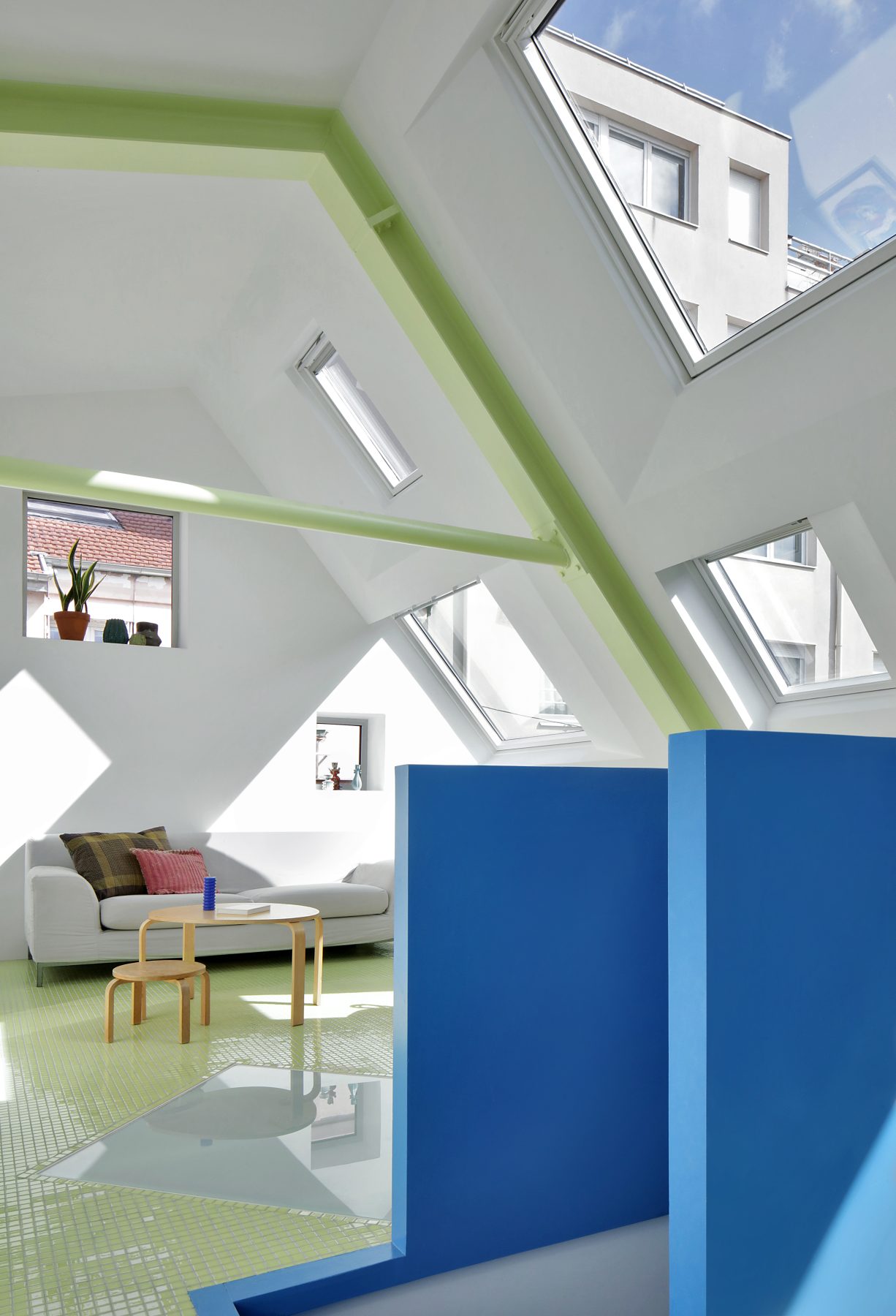
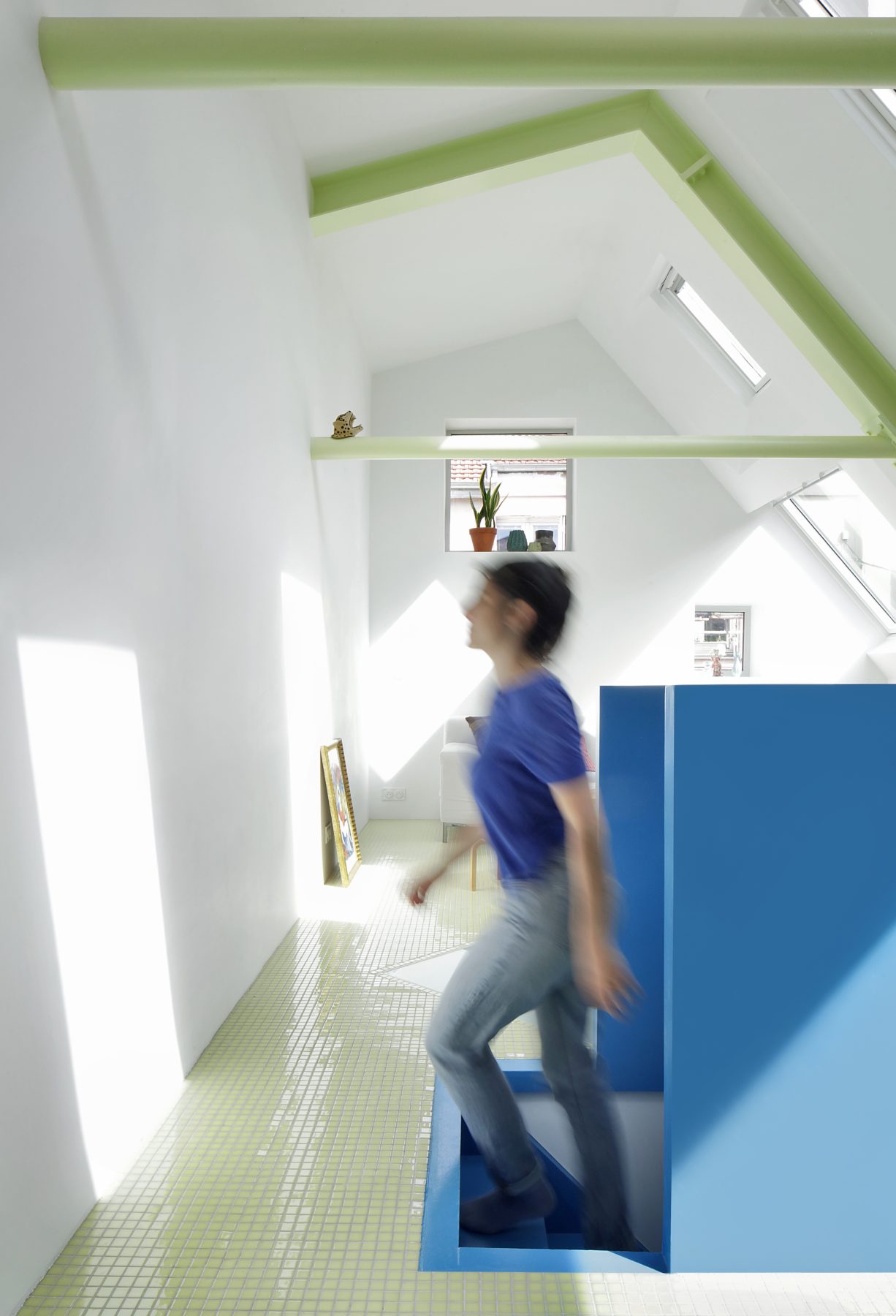
Above, the newly introduced living space opens itself to the sky, drawing daylight from multiple orientations and enabling cross-ventilation through a carefully calibrated arrangement of openings.
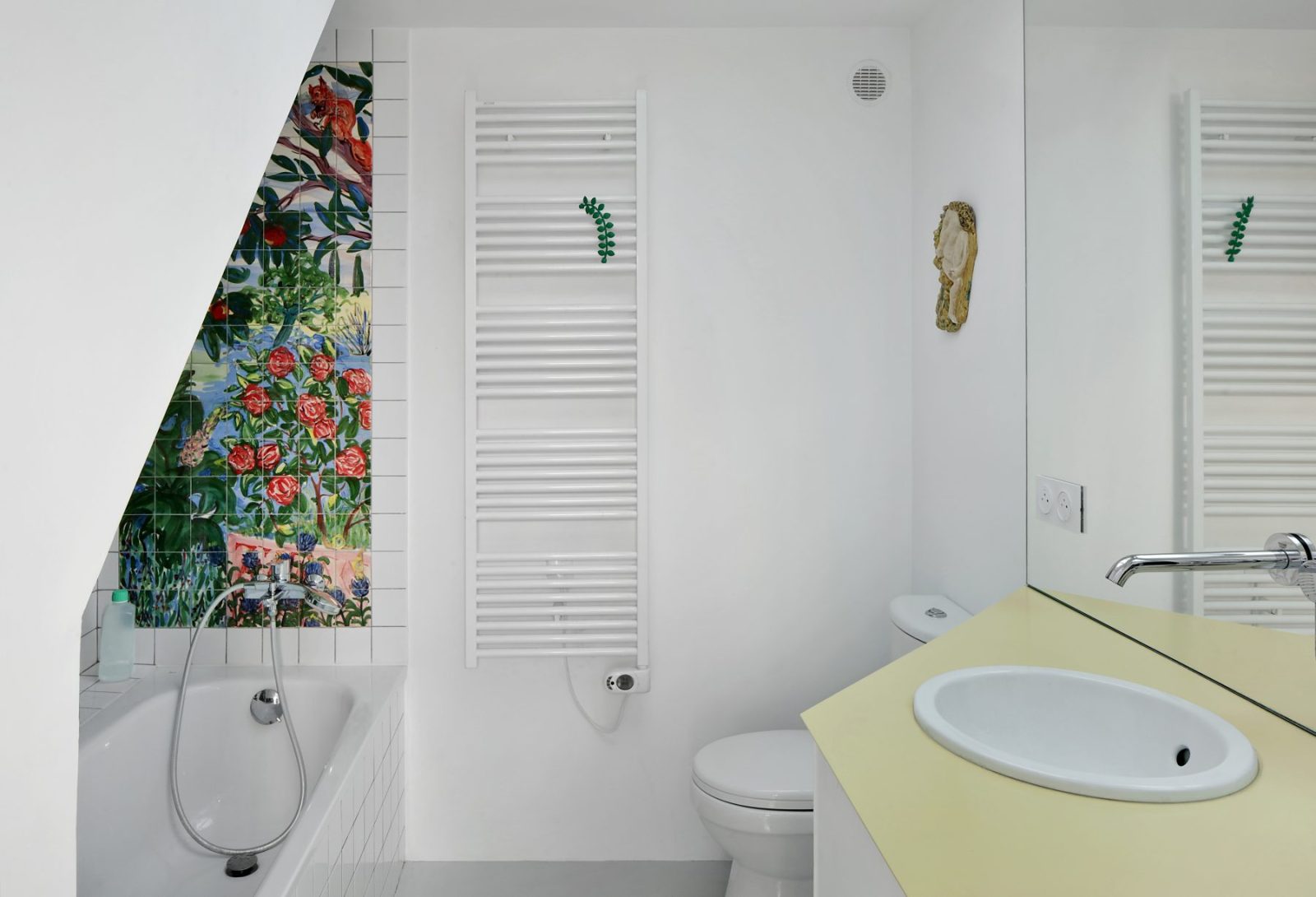
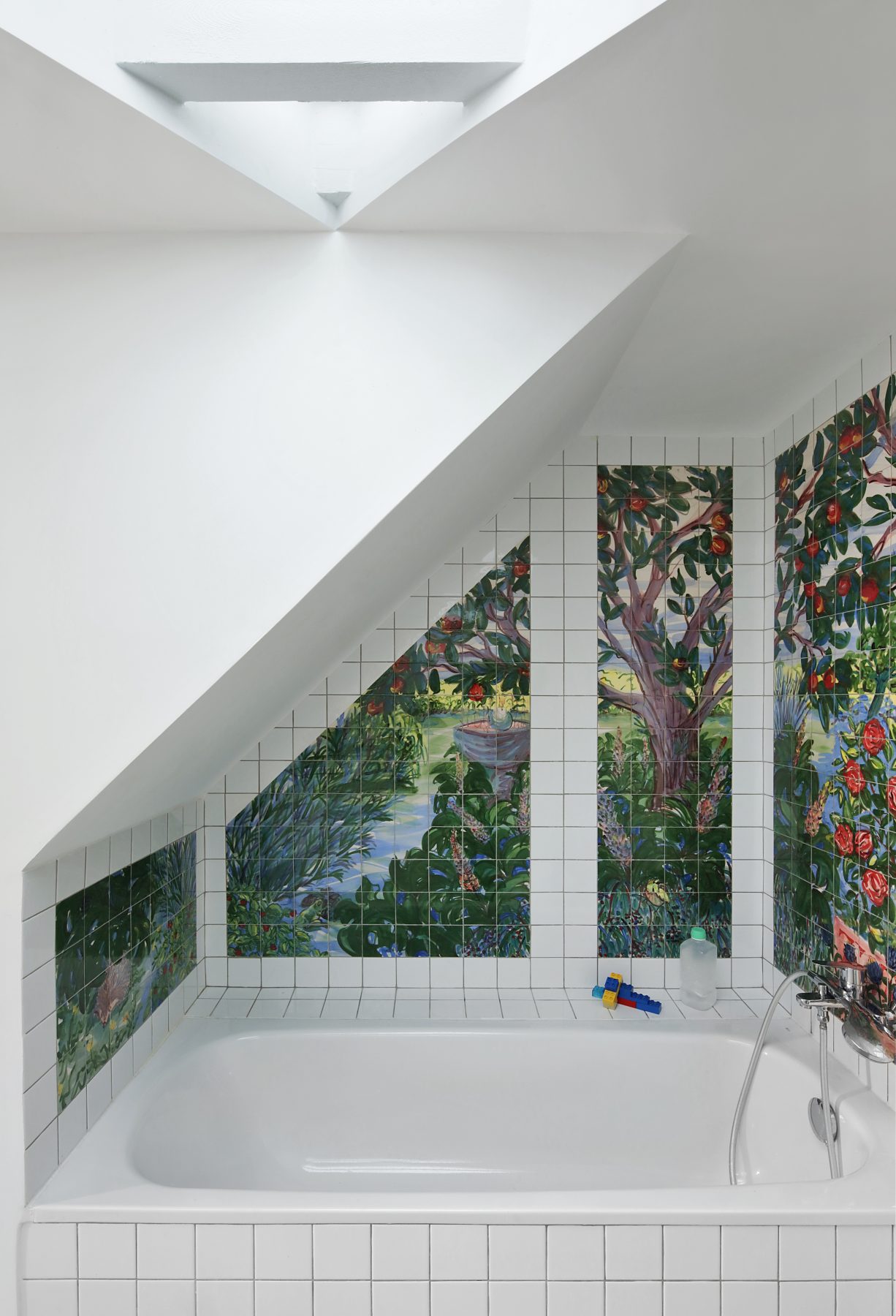
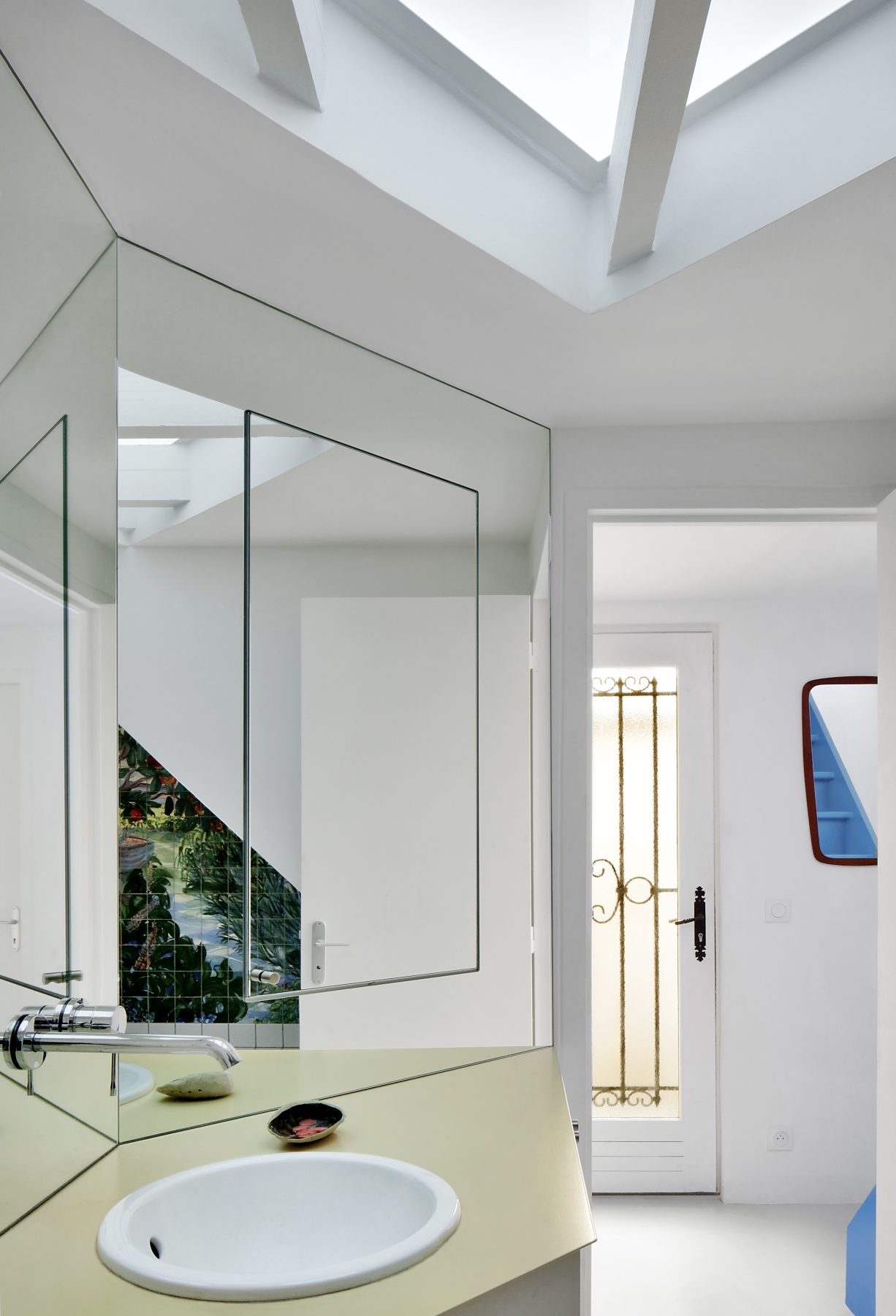
At the centre of the ground floor, the compact bathroom emerges as a quiet domestic sanctuary. A skylight washes the space in overhead light, revealing a custom-built bathtub finished with handmade ceramic tiles by Sophie de Bayser. Precisely positioned mirrors extend the perception of the space, multiplying light and dissolving its compactness into a continuous, luminous field.
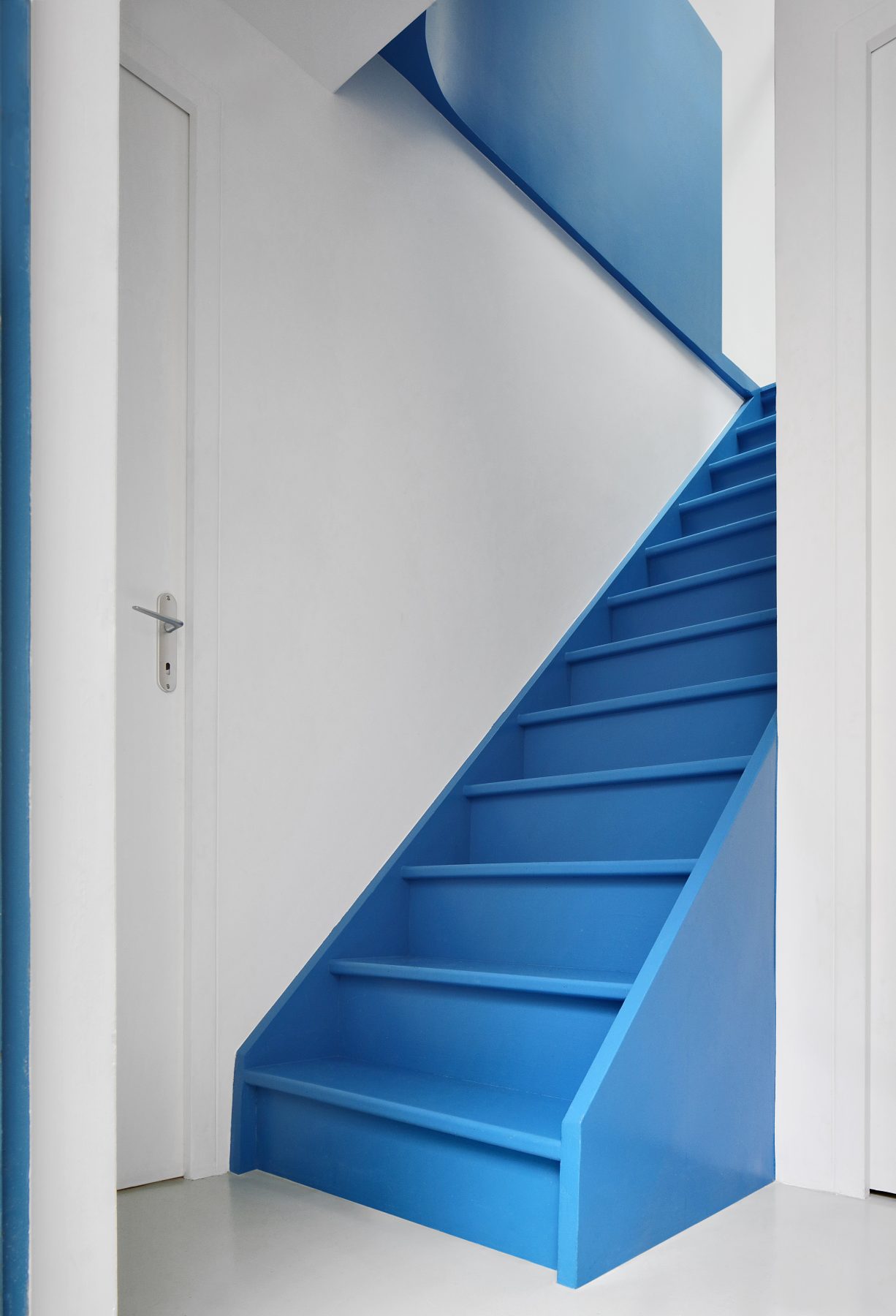
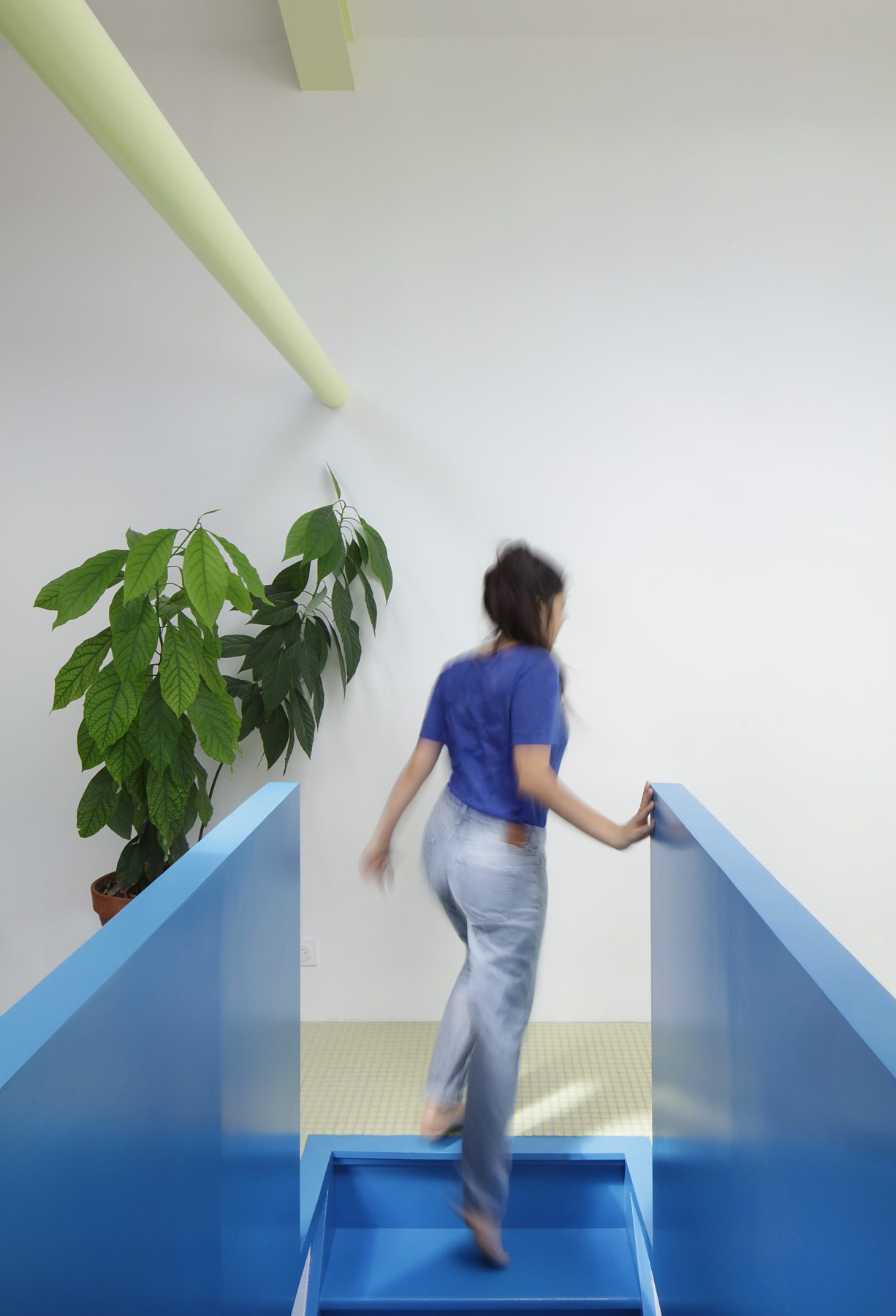
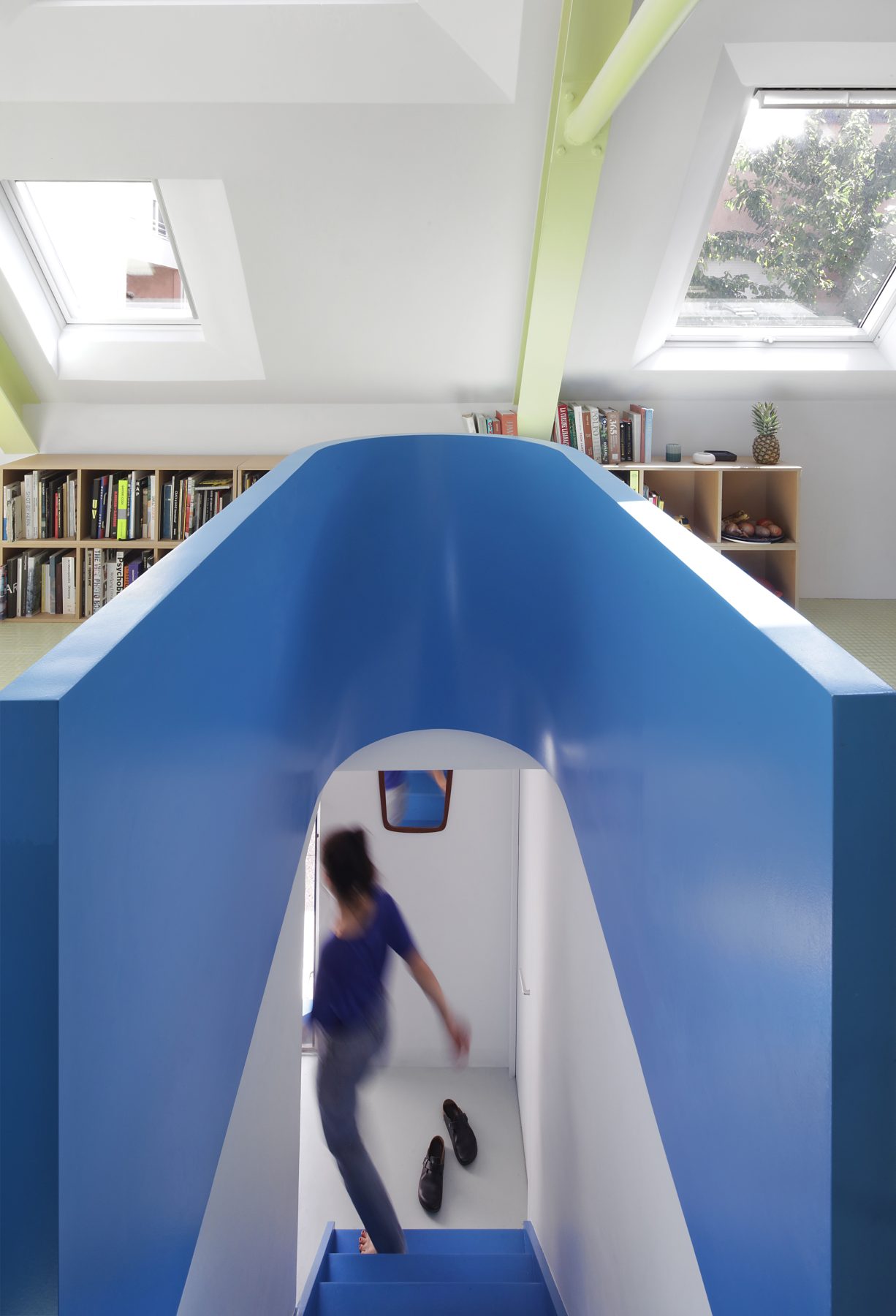
An azure-blue entrance door and a central staircase with a curved parapet establish the project’s chromatic identity.
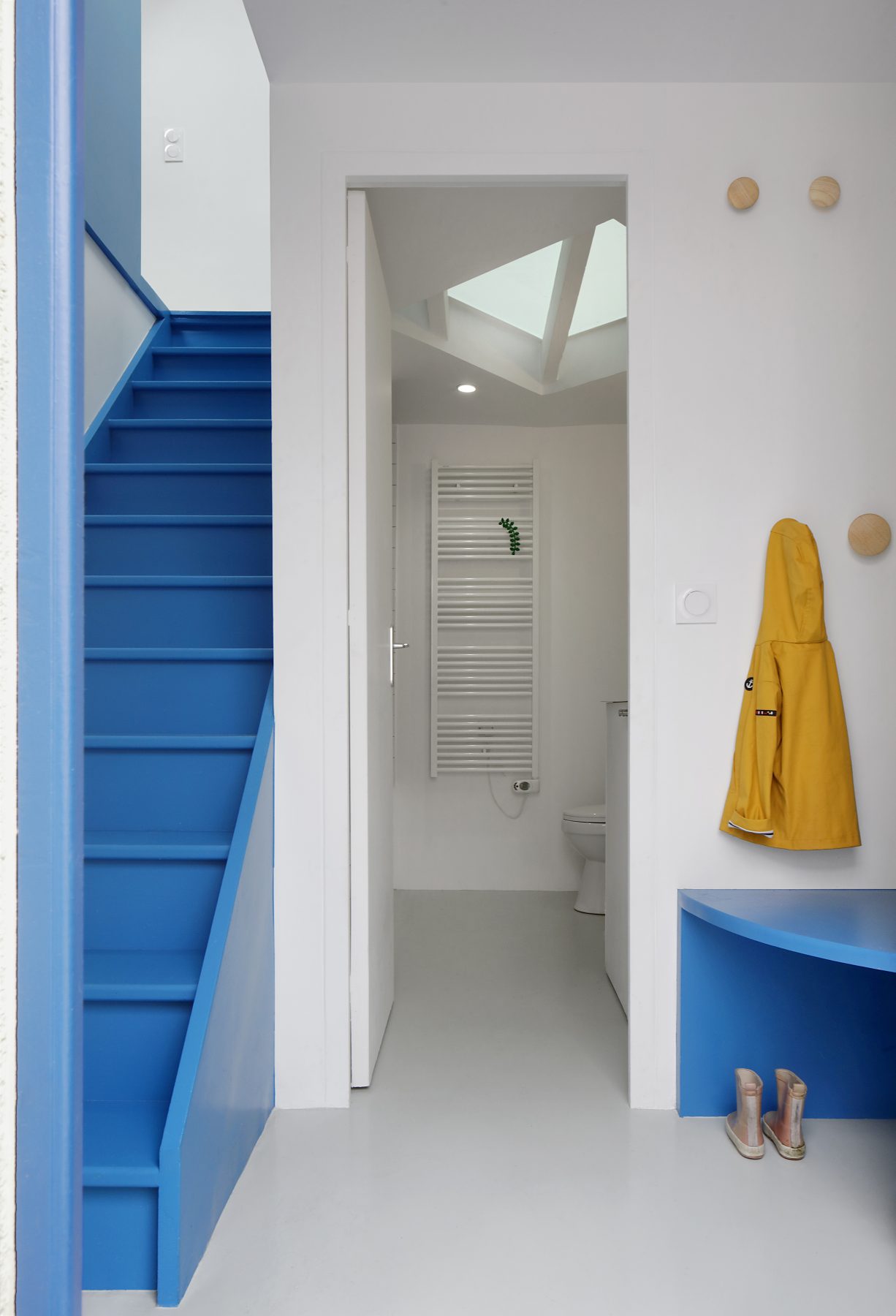
More than a circulation element, the staircase acts as a vertical thread stitching together the old and the new, the ground and the roof, the intimate and the collective.
A lightweight architecture for future lives
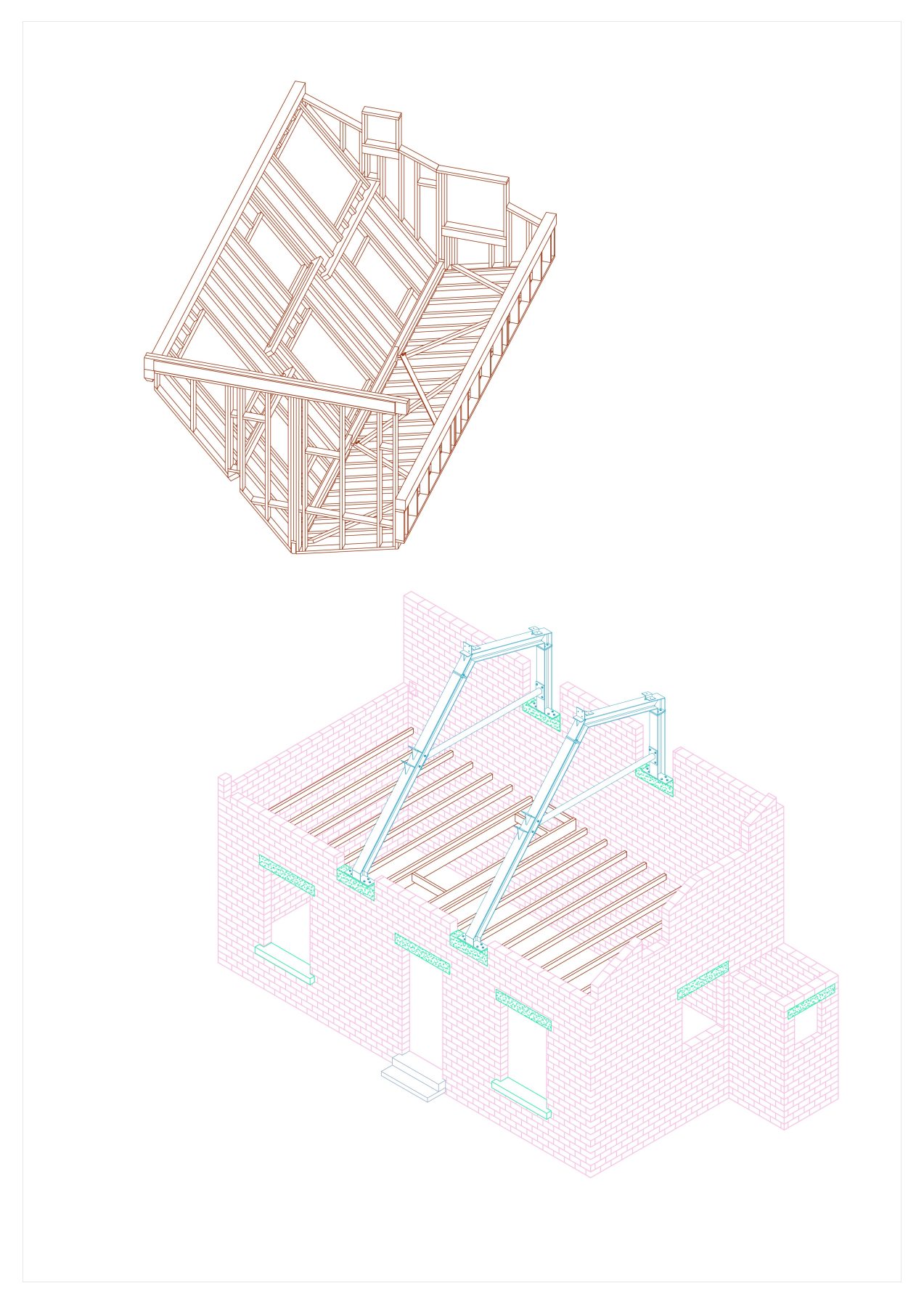
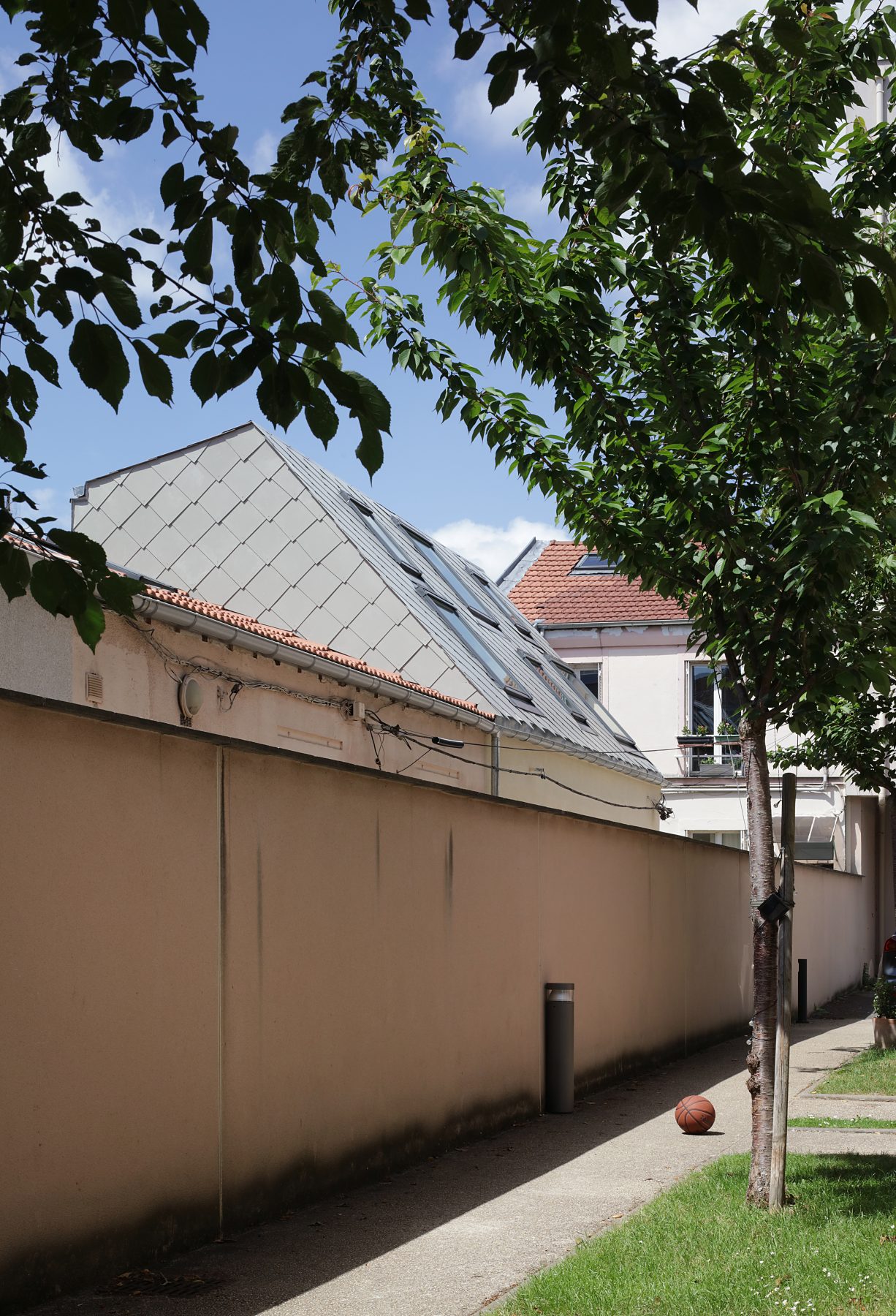
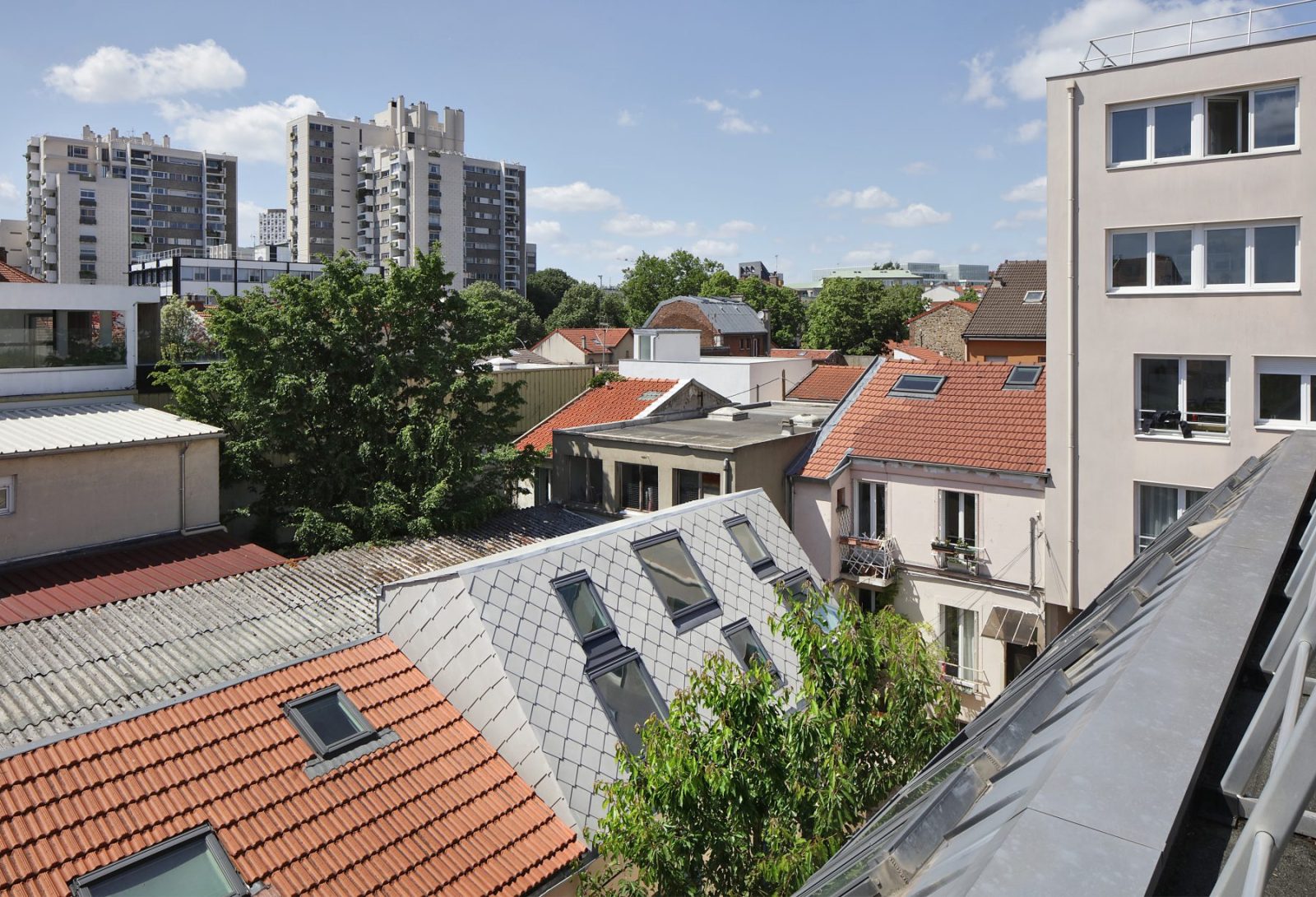
The rooftop extension responds to the structural fragility of the existing building through a lightweight construction system assembled manually due to the site’s restricted access. A timber frame insulated with recycled textile fibres is clad in Eternit fibre-cement slates—durable, thin, and lightweight panels that give the addition a quiet industrial expression.
Two exposed steel trusses, painted in a vivid lime green, remain visible within the interior. Their dimensions anticipate a possible future mezzanine, allowing the house to continue evolving according to the changing rhythms of domestic life.
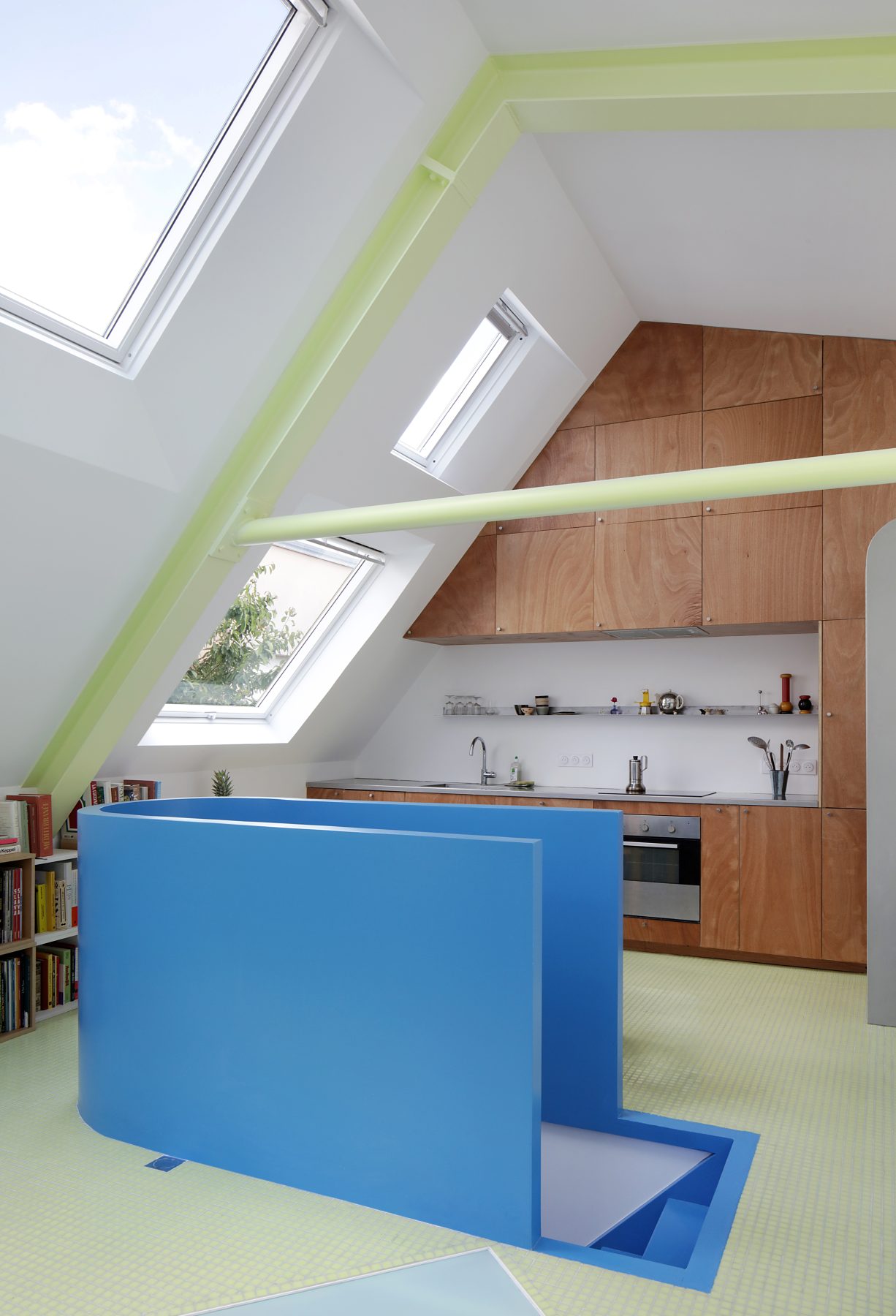
The roof geometry was carefully calibrated to preserve sunlight on the neighbouring southern façade. Existing VELUX windows were reused and combined with larger openings aligned with the kitchen and living spaces. Beneath the exposed trusses, a lime-green small-format tiled floor extends the project’s chromatic language, contrasting with the warmth of the geometrically shaped timber kitchen and the linear timber bookshelves that accentuate the inclination of the roof.
A contemporary house built upon a century of transformations
LOU does not treat the worker’s house as a nostalgic relic to be preserved untouched. Instead, it recognises its original quality: its capacity to change.
By transforming a modest workers’ dwelling into a generous and flexible domestic landscape, 127af continues the unfinished history of Bagnolet’s productive suburb. The project does not erase the past; it extends it. Like the houses that preceded it, LOU remains an architecture of negotiation—capable of growing, contracting, adapting, and accommodating the unpredictable rhythms of life.
In an era increasingly aware of the ecological cost of demolition and reconstruction, the project suggests that the future of housing may not lie in building anew, but in learning how to extend the stories already inscribed in matter.
Facts & Credits
Project title LOU-Elevation of a Family House in Bagnolet
Typology Stories of Contemporary Domesticity, Roof Extension, Renovation
Episode 21st
Location Bagnolet, Paris, France
Status Completed, 2025
Architecture 127af
Structural engineer Structura Lab
Ceramic tiles Sophie de Bayser
Photography Filip Dujardin
Bibliography
Rudofsky, Bernard. Architecture Without Architects: A Short Introduction to Non-Pedigreed Architecture. New York: Museum of Modern Art, 1964.
Habraken, N. John. Supports: An Alternative to Mass Housing. London: Architectural Press, 1972.
Choay, Françoise. L’Urbanisme, utopies et réalités: Une anthologie. Paris: Éditions du Seuil, 1965.