The Architect’s Office series explores the workspace as both laboratory and mirror of architectural thinking. It looks beyond representation to uncover how space, rituals, tools, and everyday practices inform design culture. Within this framework, the studio is not merely a place of production, but a spatial manifesto—where ideas are tested, identities are constructed, and architecture begins to take form.
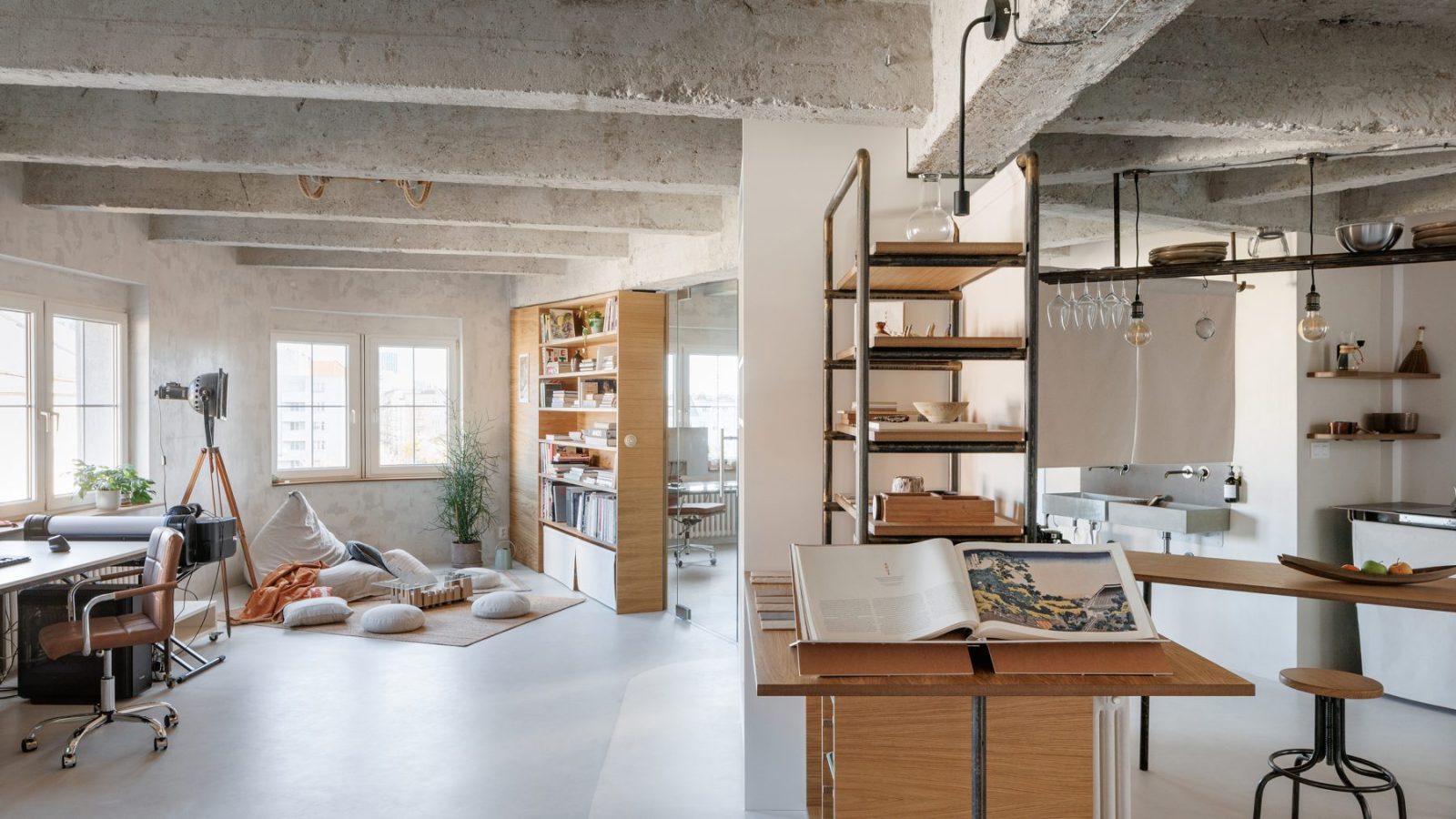
In Bratislava, alchitekt studio by Andrea Lizáková unfolds within a former residential interior on the top floor of a historic 1928 building designed by the renowned Slovak architect Juraj Tvarožek, quietly negotiating between past and present, structure and use. Beneath a brutalist ceiling of exposed concrete beams, and among movable fabric panels, wheeled desks, and plant pots, the space accommodates multiple modes of working. Combining an architecture office with a laboratory for material experimentation and a workshop for woodcarving and pottery, the studio operates as a lived reflection of the architect’s approach—an architecture grounded in memory, material awareness, and the subtle choreography of everyday life.
Andrea Lizáková’s work is grounded in an attentive reading of place—not as a fixed condition, but as an accumulation of lived experiences. Spaces once inhabited, materials once touched, atmospheres once felt continue to inform her design approach, resurfacing as subtle spatial decisions rather than explicit references.
“My work emerges from the contextuality of place and draws from experiences that have stayed with me.”
Her trajectory unfolds across a series of distinct yet complementary contexts. Beginning in Bratislava, her education established a foundation in abstract thinking and spatial composition. A semester in Saint-Étienne, France introduced a more discursive culture, where form was inseparable from the ideas that produced it, and material experimentation became a tool of inquiry. In Umeå, Sweden this duality evolved into a synthesis of making and research—hands-on practice supported by workshop culture alongside urban studies grounded in contemporary conditions.
Further experiences sharpened this position. In Moscow, Russia within the studio of Yuri Grigoryan, the pace and intensity of work redefined her understanding of discipline and production. In Tokyo, Japan working at Kengo Kuma and Associates, she encountered a different architectural sensibility—one rooted in precision, atmosphere, and the careful negotiation between tradition and innovation.
“I had the opportunity to develop my work across cultural differences and work on both large and small-scale projects in various countries.”
Returning to Slovakia, her engagement with local practice grounded these accumulated experiences in a more immediate context. Within her own work, these influences do not resolve into a singular method but form an open platform—one that allows different approaches, cultures, and ways of making to intersect.
“I transform the experiences I’ve gained into a kind of platform where different approaches and worlds can connect.”
At the core of Lizáková’s thinking lies an understanding of space as something deeply internalized. The environments we move through—from early childhood onwards—form a subconscious archive of spatial impressions: light, texture, smell, scale, atmosphere. These impressions shape how we perceive and evaluate space long before conscious analysis takes place.
“Our subconscious continuously collects information, which it then uses to evaluate new experiences: Will I feel good here? Am I safe here?”
She describes these accumulated impressions as “basic scenarios”—archetypal spatial conditions such as refuge, openness, intimacy, or exposure. A kitchen where a family gathers, a winter garden filled with light, a quiet enclosed room—these are not typologies but lived constructs that continue to inform spatial expectations.
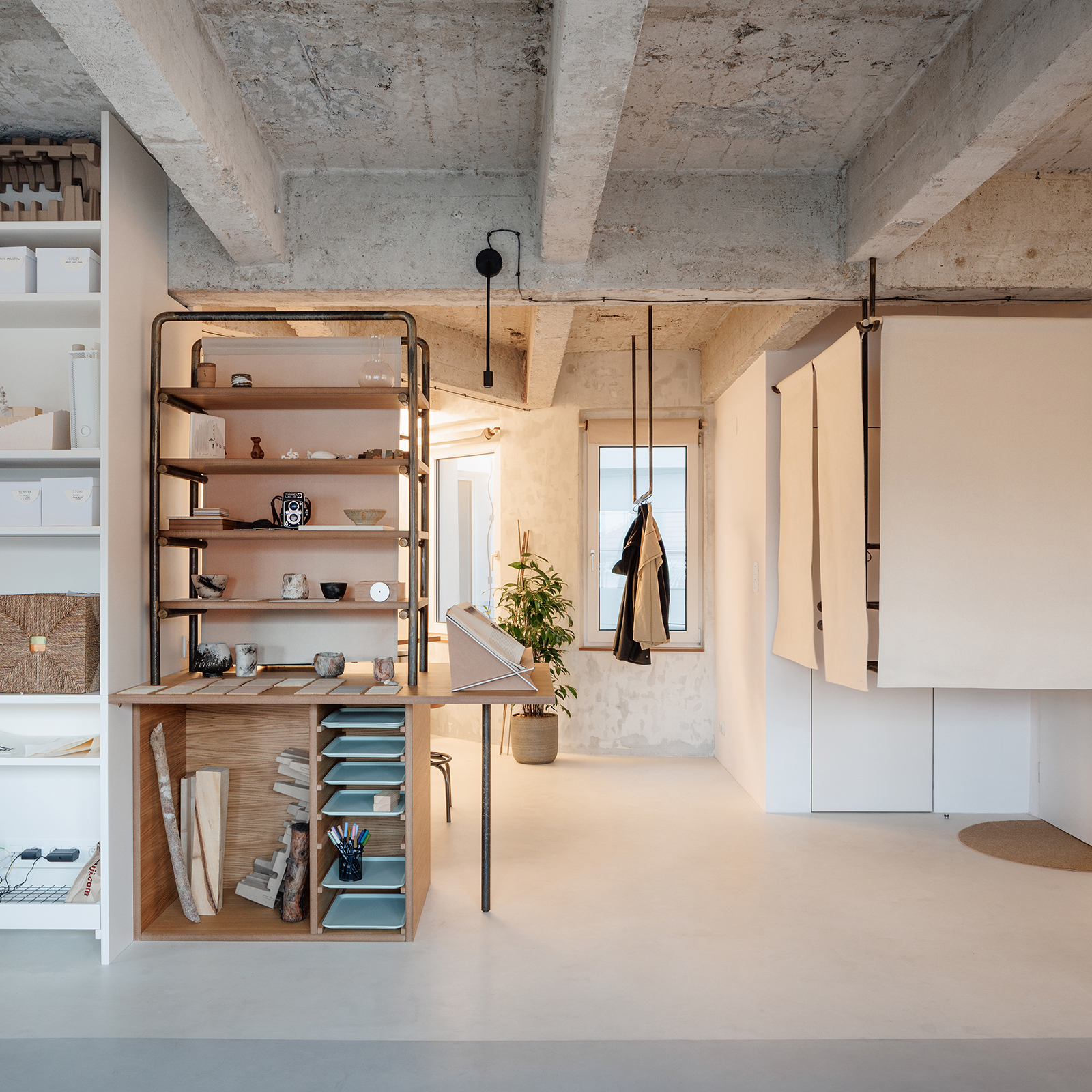
Design, in this sense, becomes an act of calibration: a way of shaping conditions that resonate with these internalized experiences while opening up new possibilities for inhabitation.
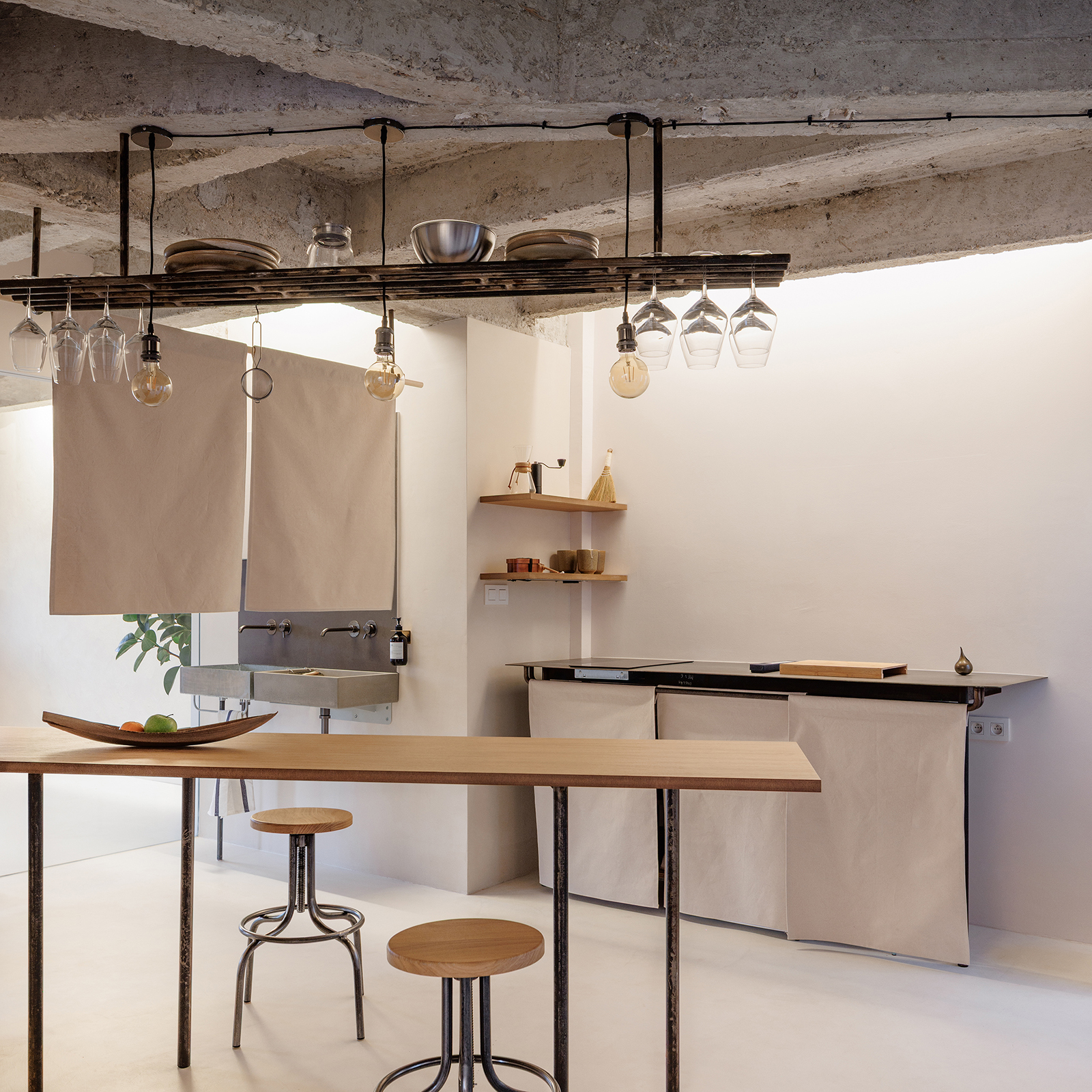
This line of thinking finds a precise spatial translation in Alchitekt Studio, her own workspace in Bratislava. Located within a former residential apartment on the top floor of a 1928 building designed by Juraj Tvarožek, the project operates as both workplace and testing ground—a space where architecture, making, and everyday rituals intersect.
The intervention is guided by a logic of revelation.
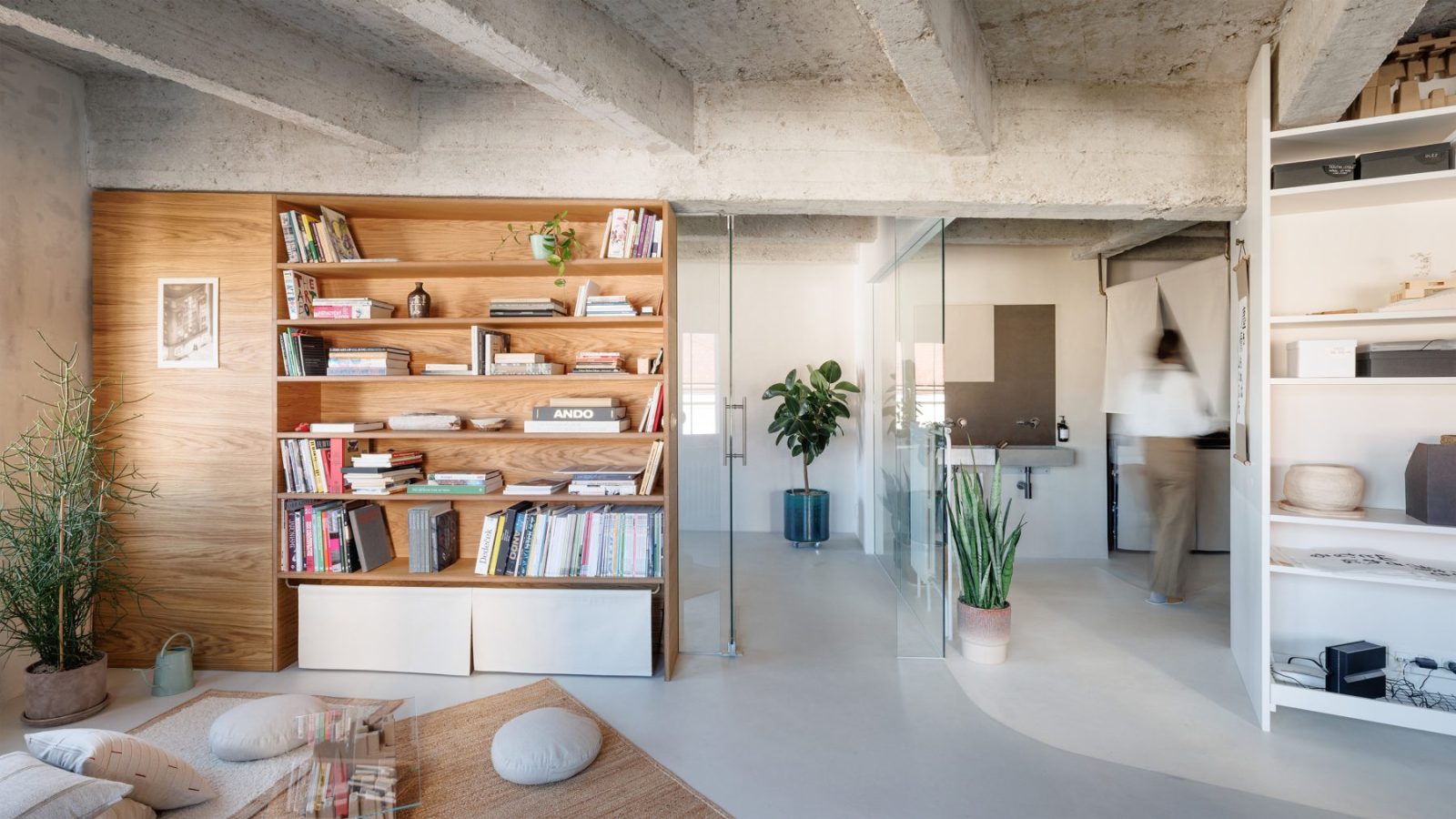
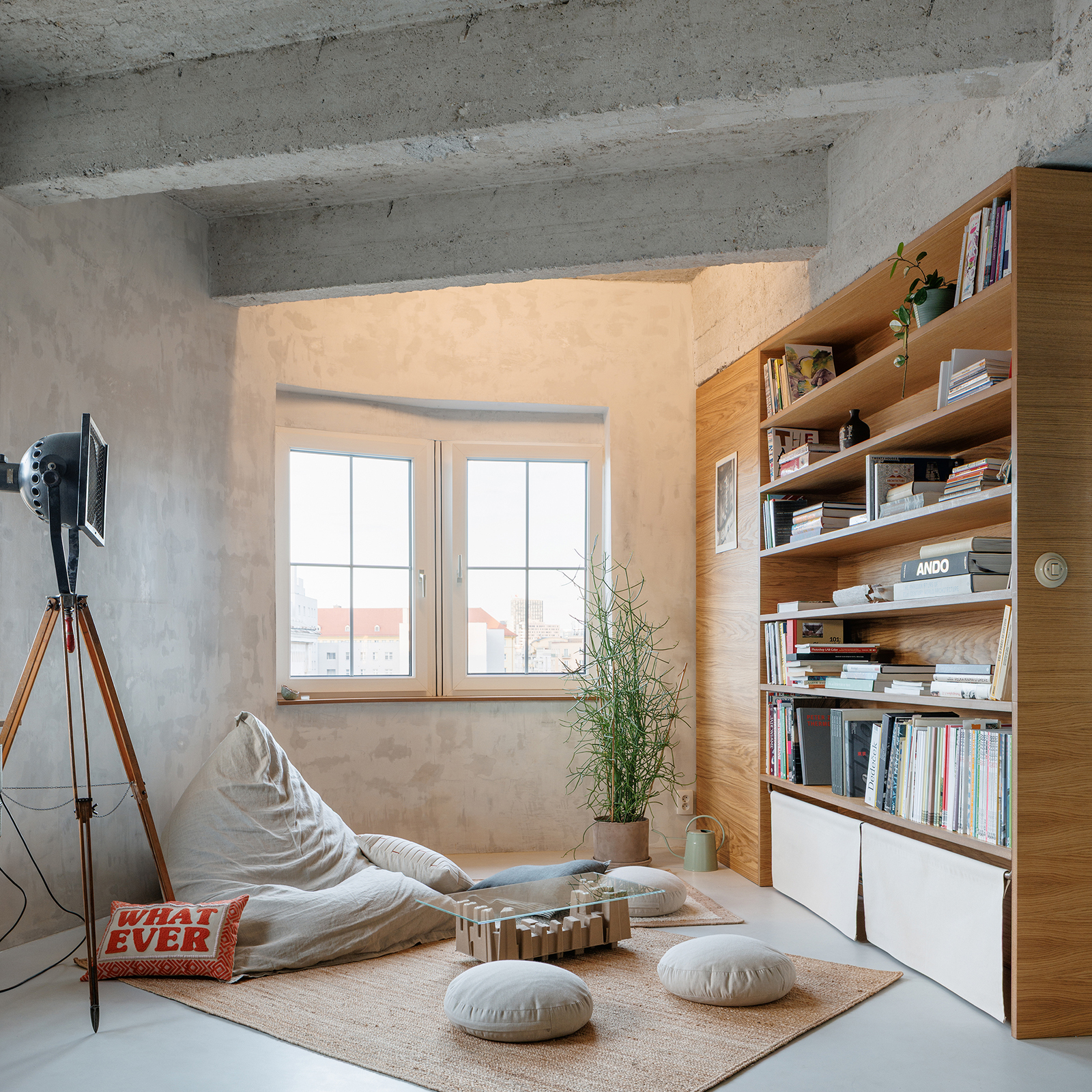
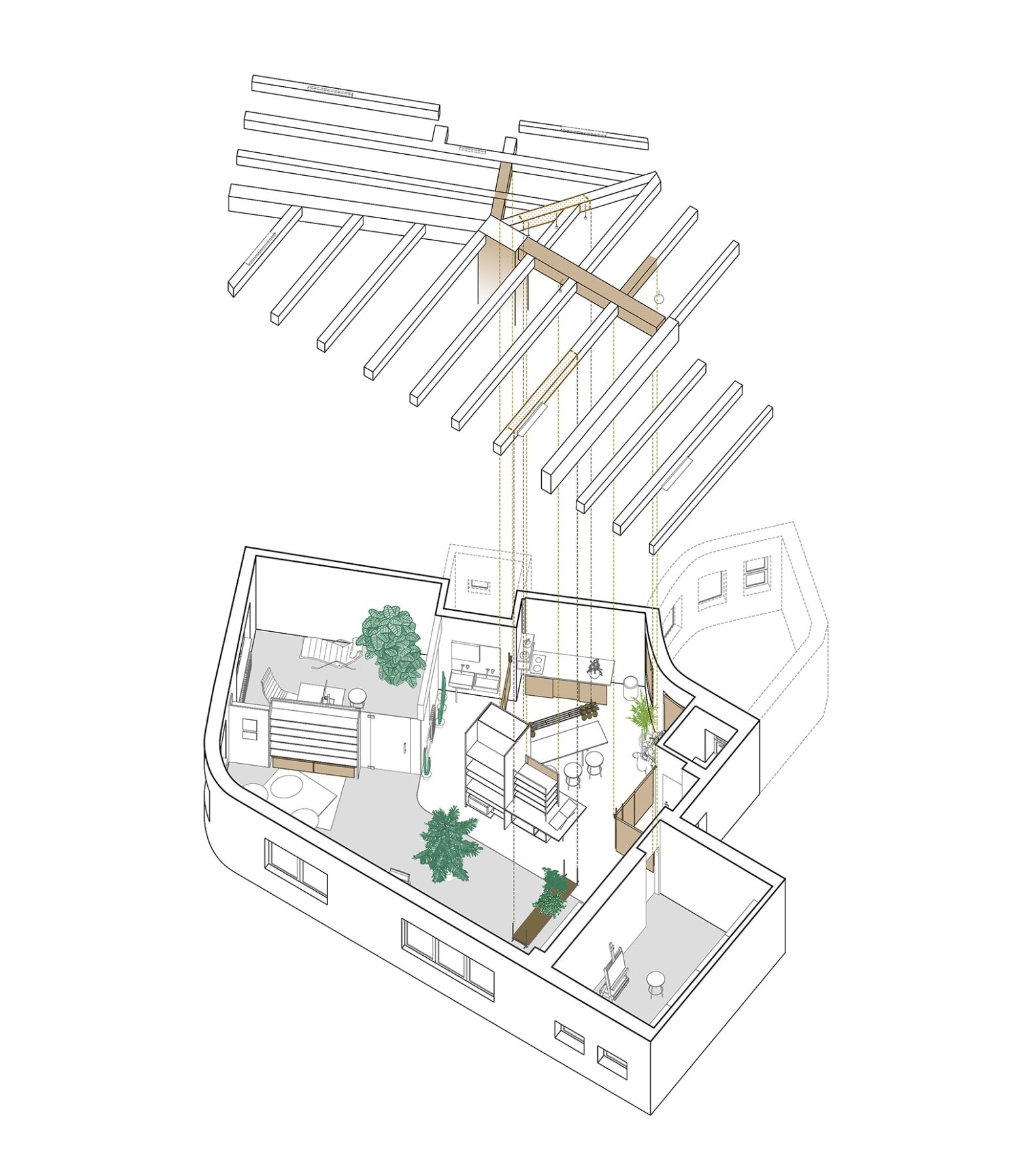
The most defining gesture is the exposure of the ceiling: a system of branching reinforced concrete beams, previously concealed beneath layers of plaster. Their uncovering is not merely aesthetic but conceptual—an act of engaging with the building’s latent structure.
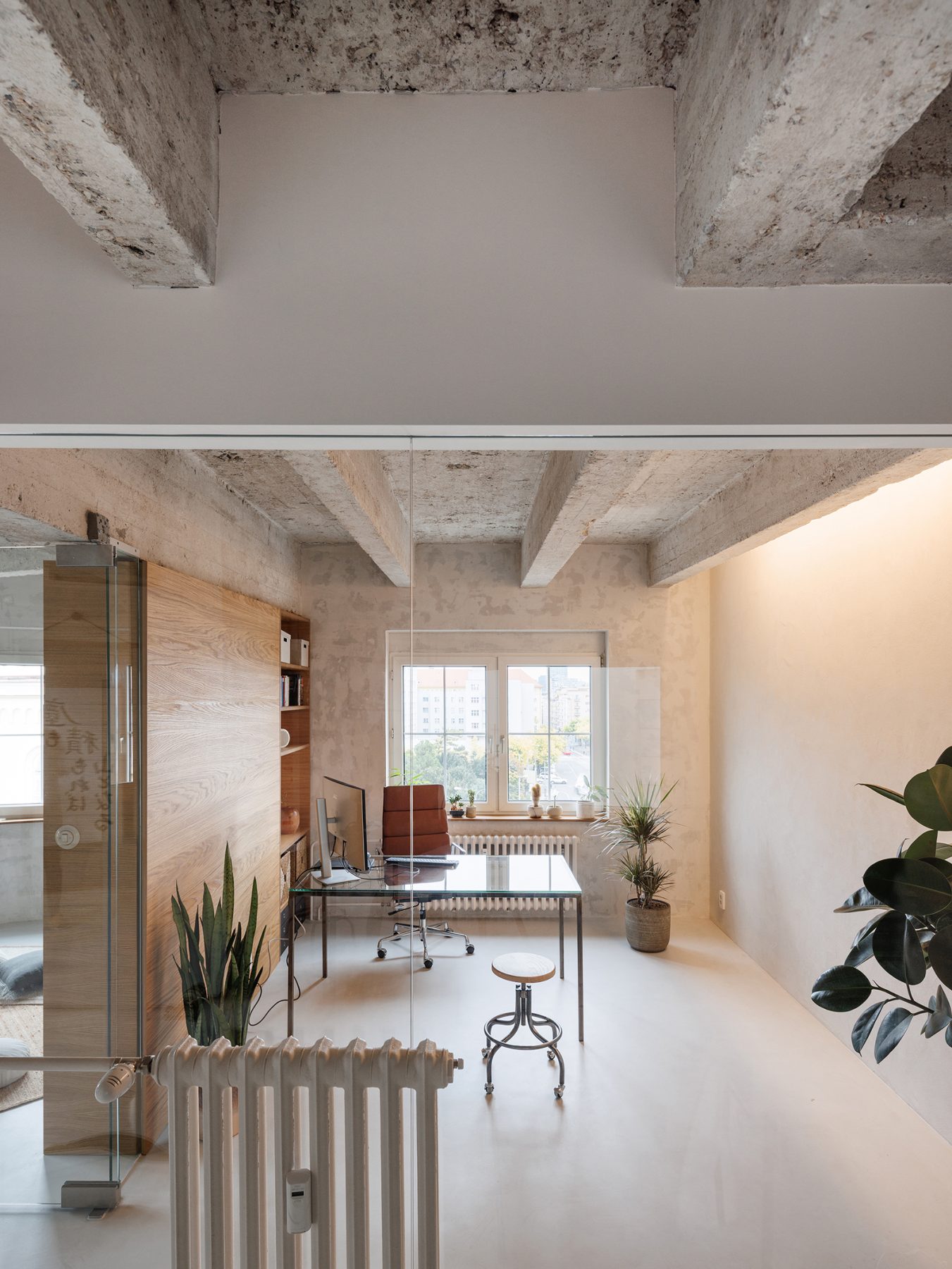
“Restoring the concrete beams to their original exposed state was probably the most arduous task of the renovation. Designing with them, not against them, proved beneficial.”
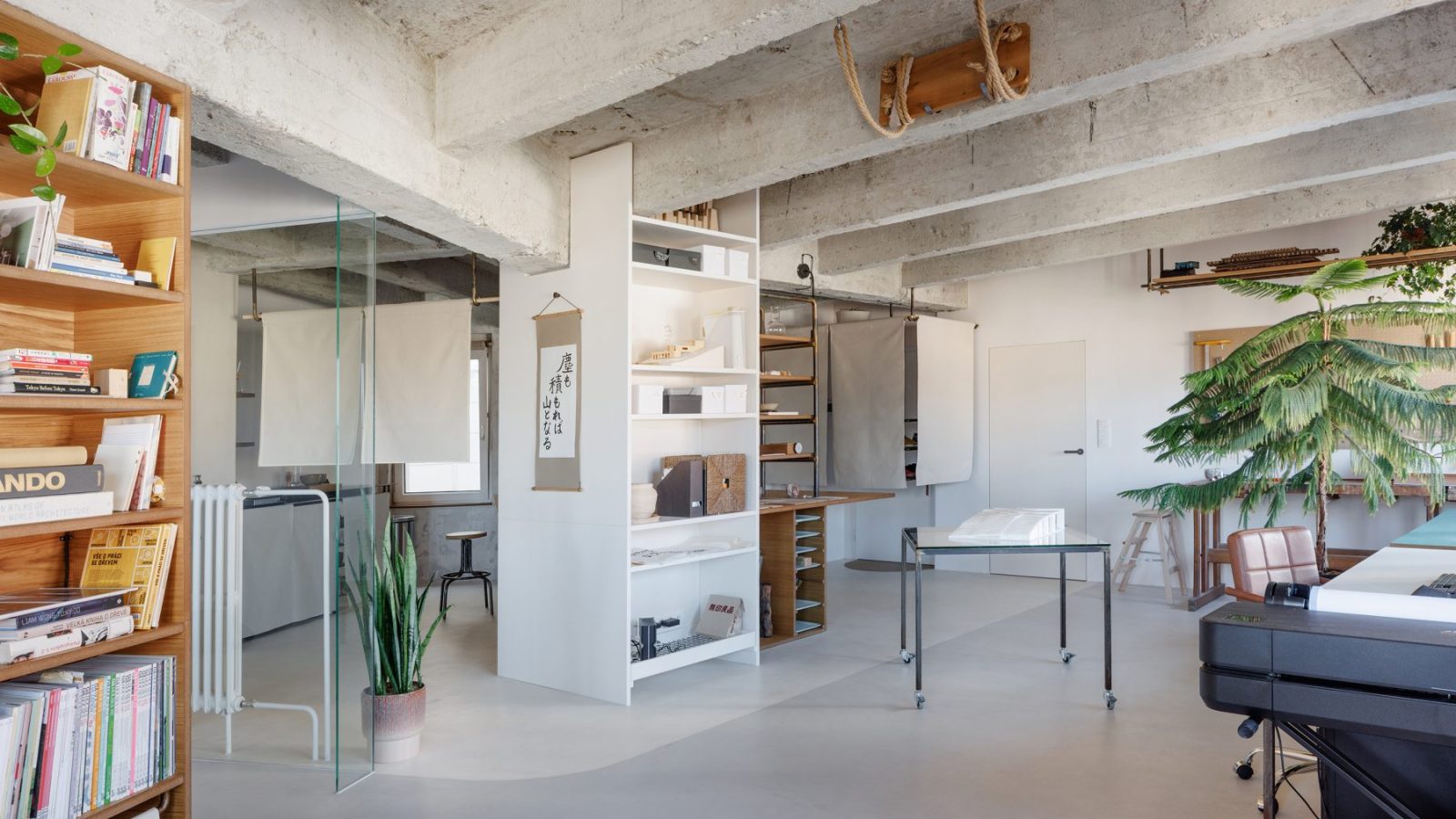
The beams are not perfectly horizontal; they follow a subtle upward slope toward the façade. Rather than correcting this irregularity, the project embraces it, allowing the existing geometry to guide the spatial organization. Light is integrated within this framework. LED strips concealed along the edges of the beams create indirect illumination, dissolving the source and amplifying the spatial depth.
The ceiling becomes both structure and atmosphere—a continuous field that organizes the space below.
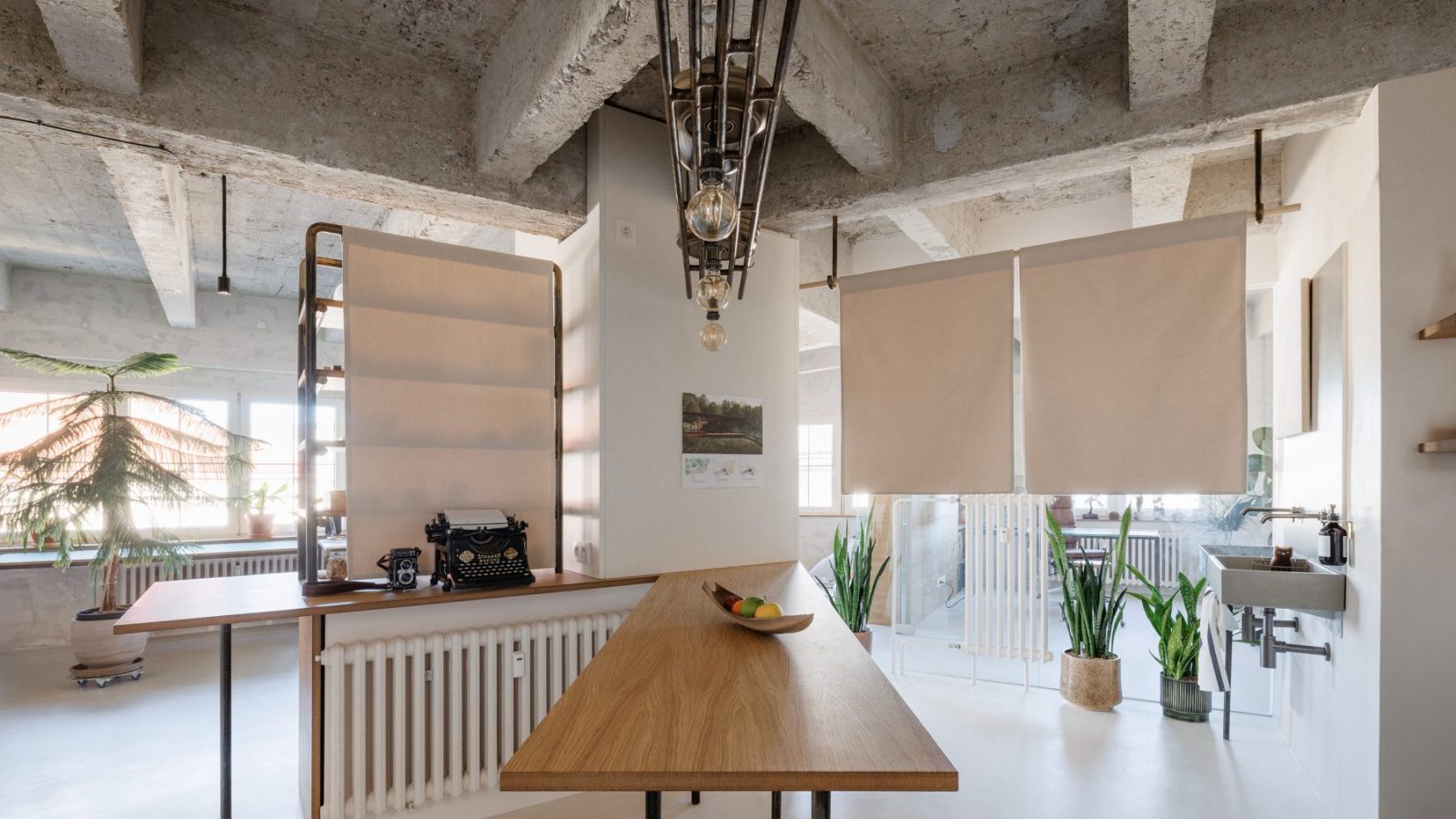
In response to its visual weight, all newly introduced elements are deliberately light and reversible.
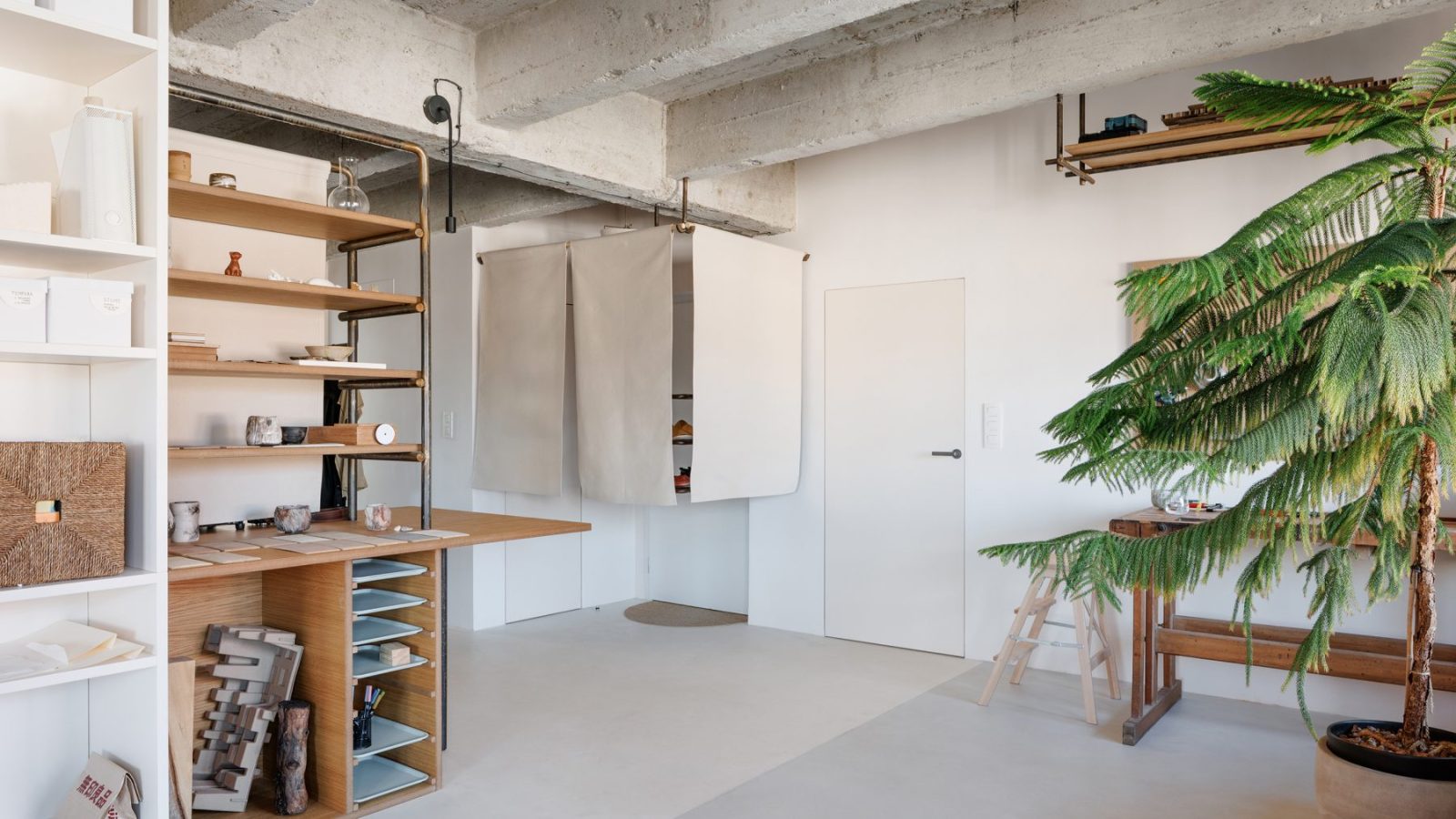
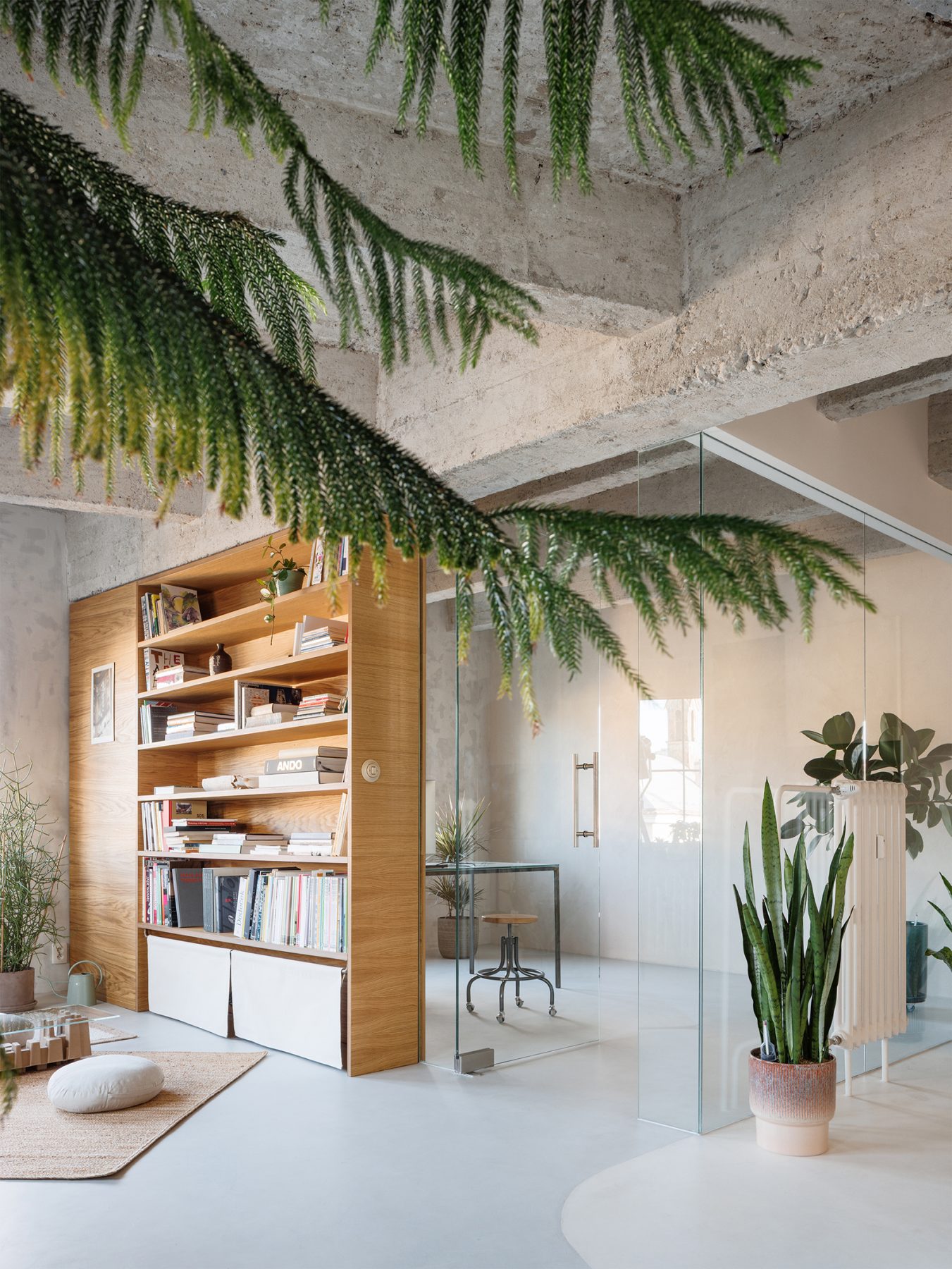
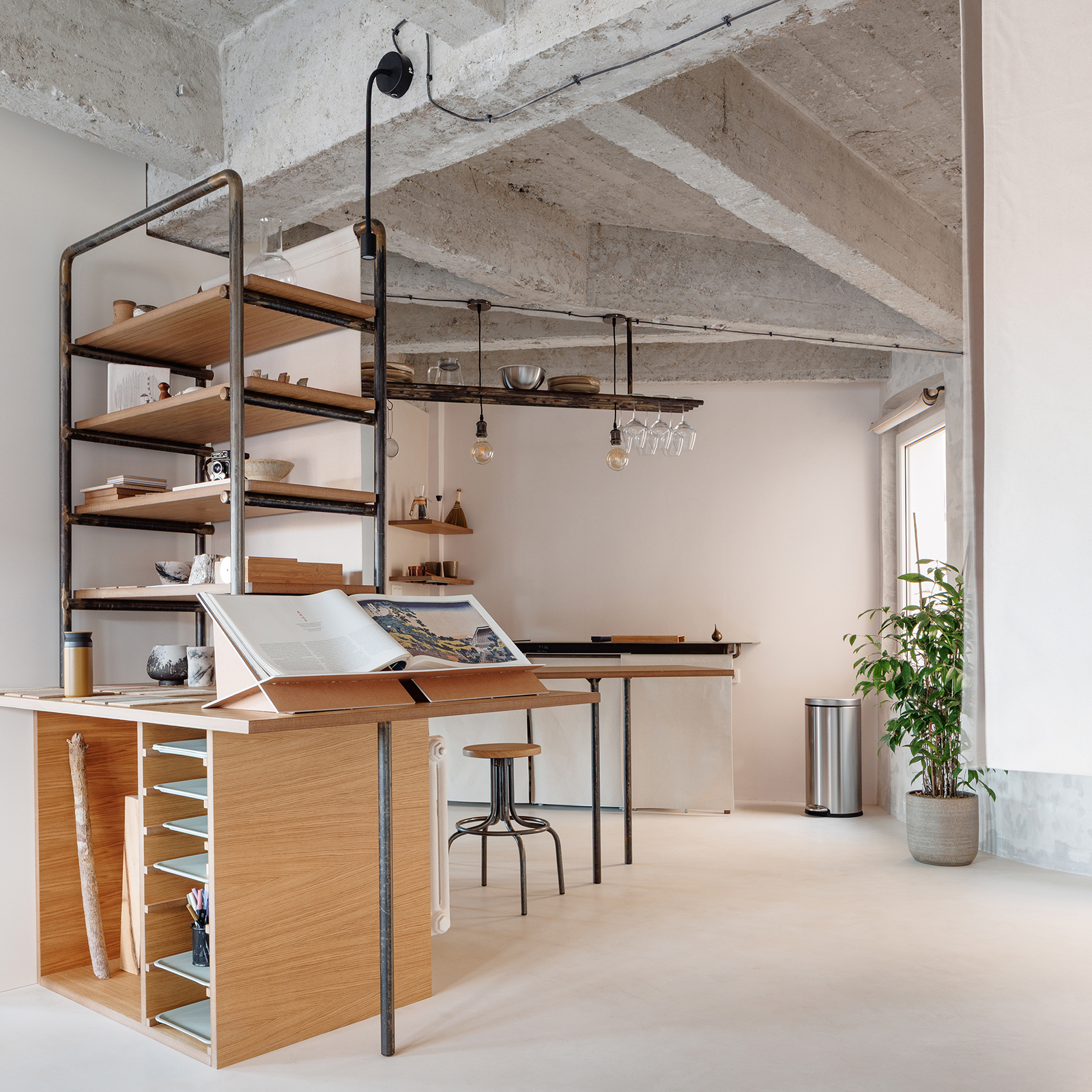
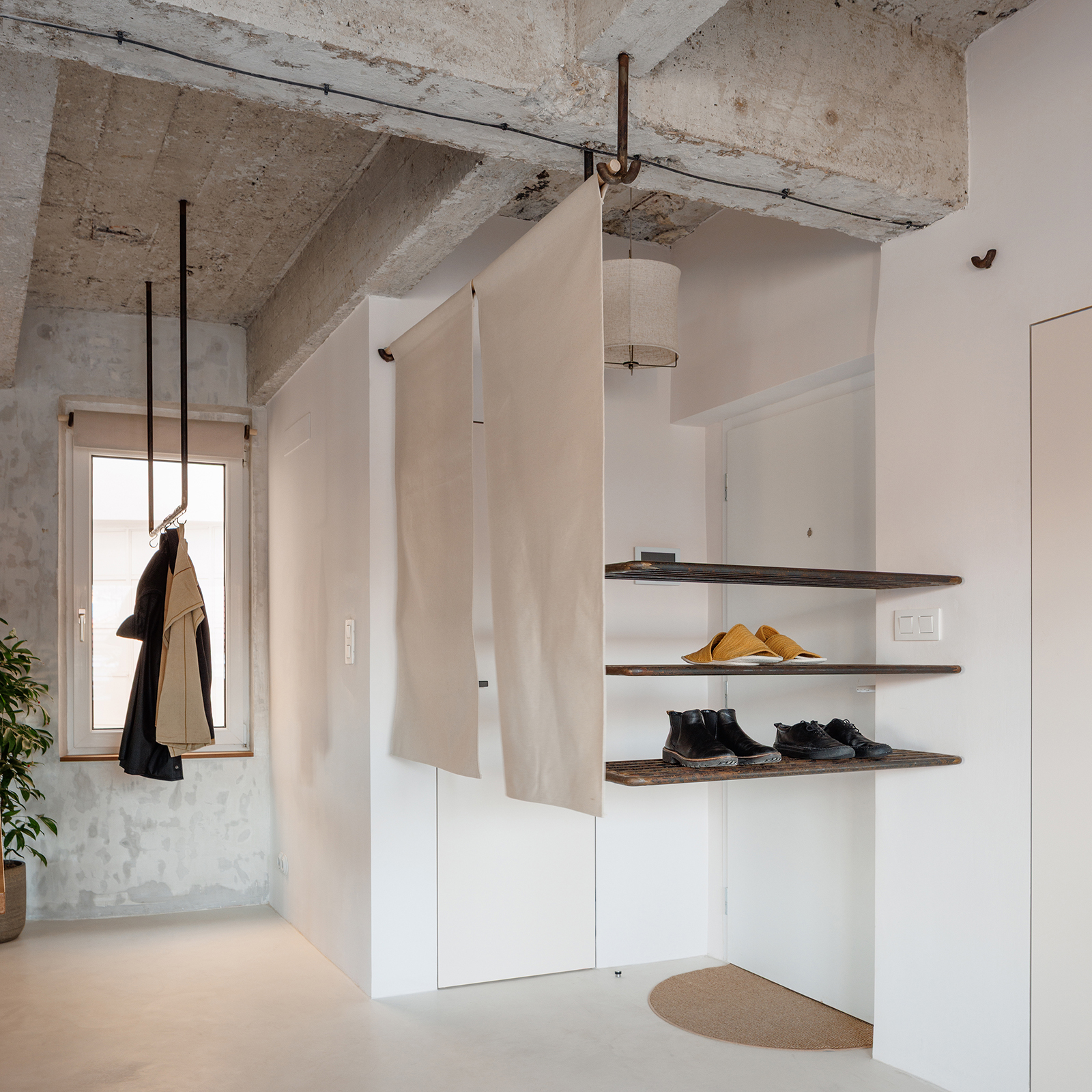
Glass partitions, tubular steel furniture, and suspended canvas screens define space without enclosing it. The interior remains open, yet articulated through subtle thresholds. The spatial organization follows the beam grid. Furniture and storage elements align with the existing structure, avoiding conflict while allowing smaller zones to emerge—spaces for concentration, conversation, and making.
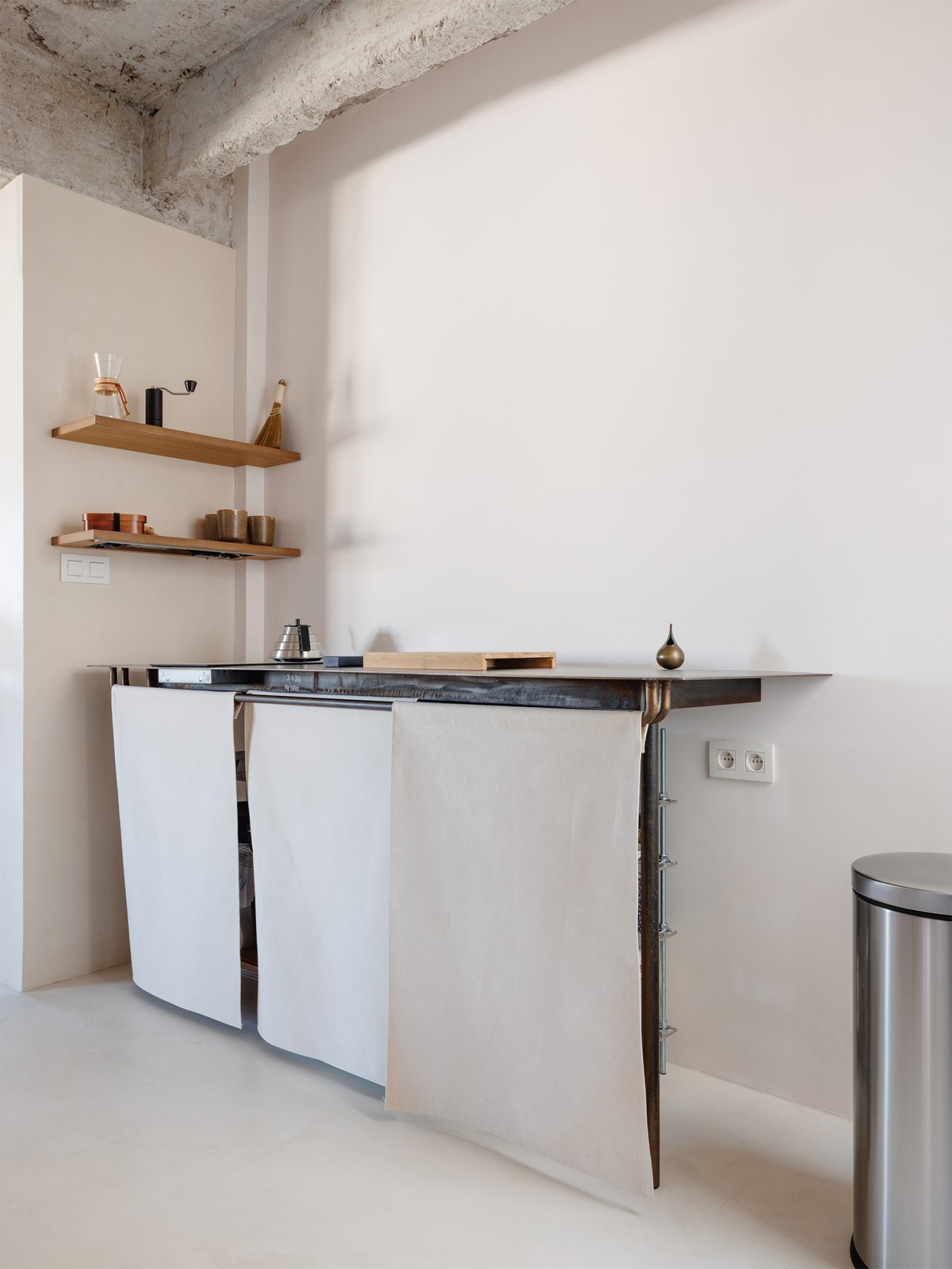
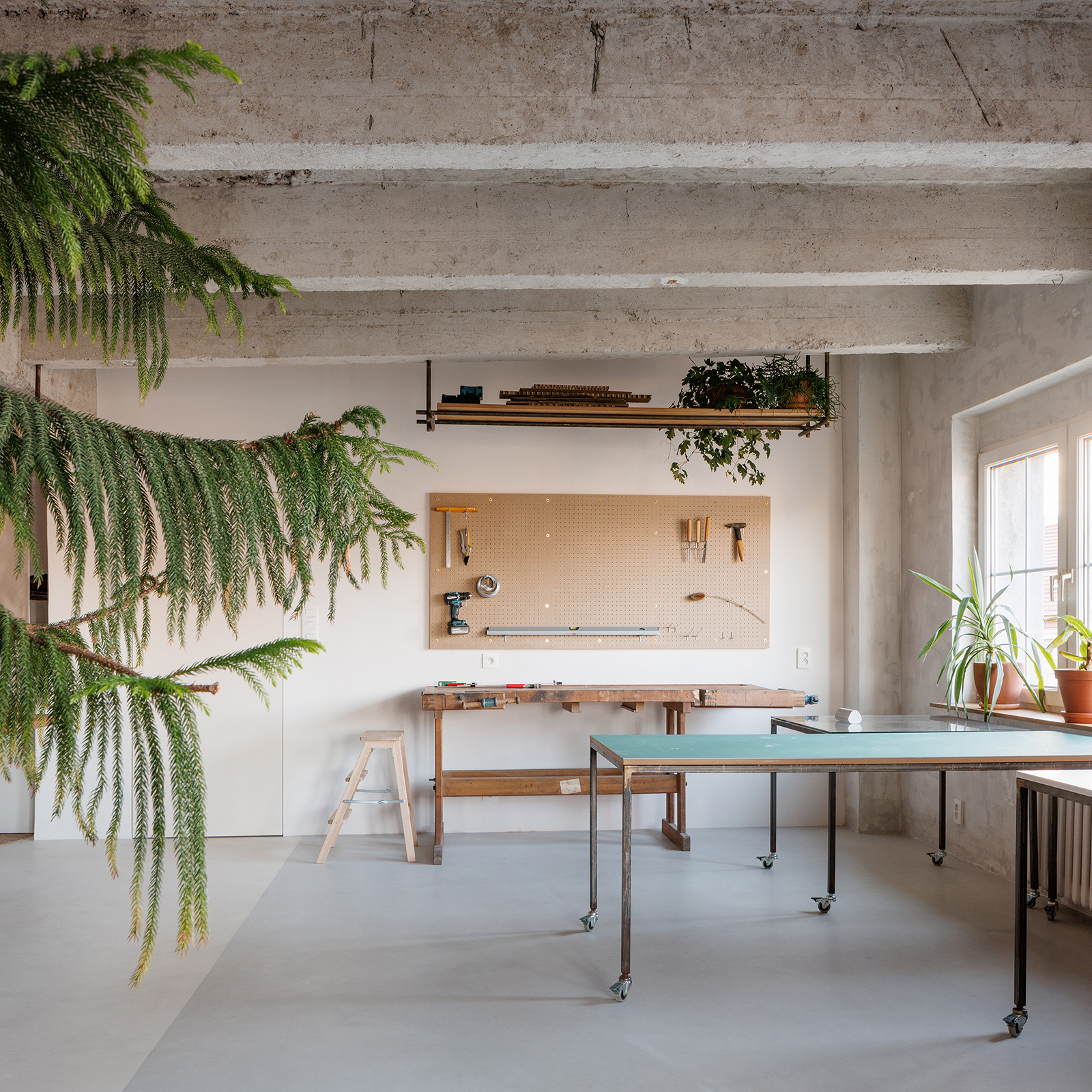
Two primary areas are defined through floor color: a white “clean” zone for meetings and presentations, and a gray work zone for more intensive production. Within the latter, mobility is key—desks on wheels allow for constant reconfiguration, reinforcing the idea of space as a process rather than a fixed condition.
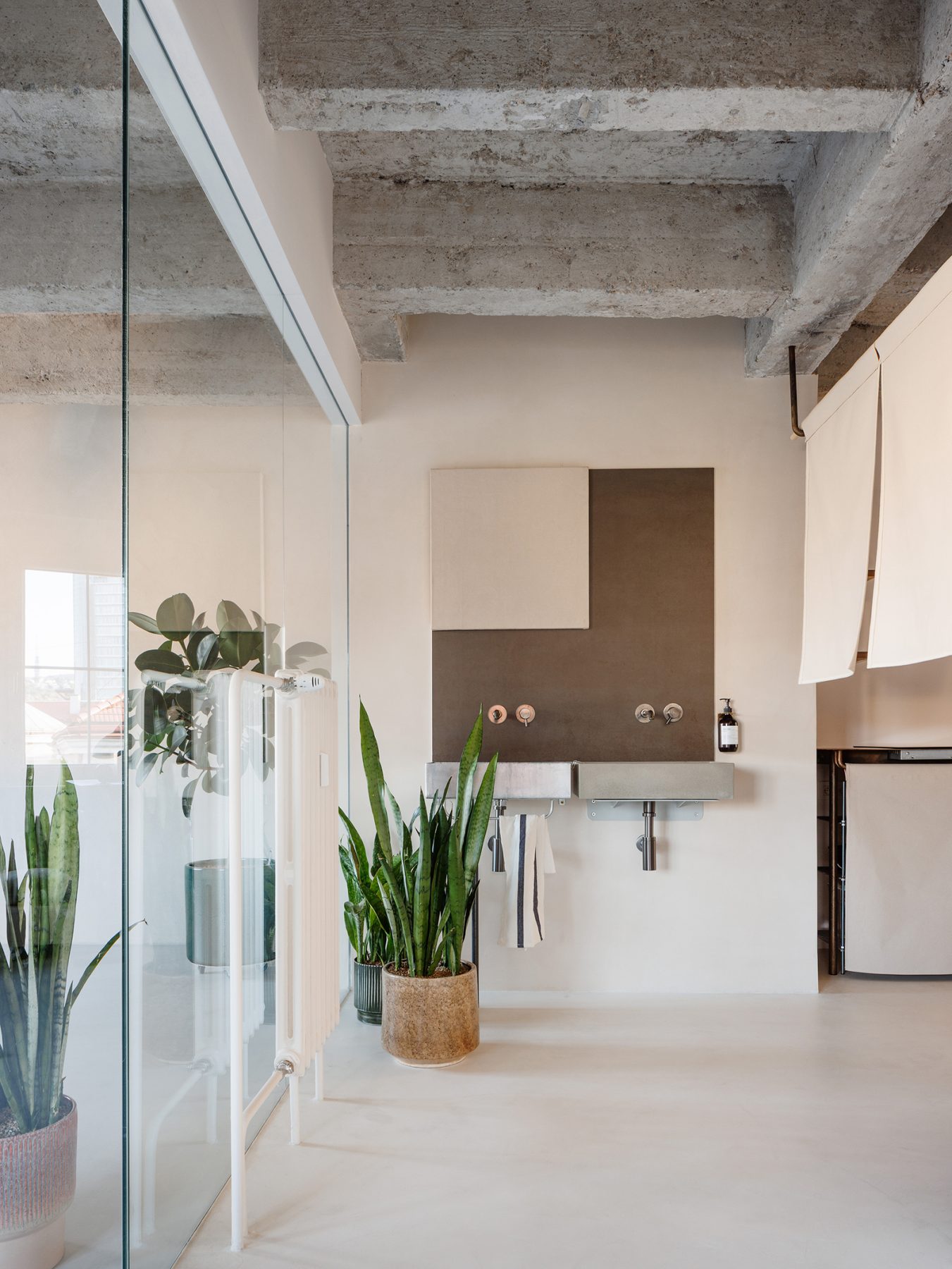
Materially, the project engages in a dialogue between past and present. Wood and steel—already embedded in the building—are reintroduced in raw, expressive forms. Weathered metal elements echo the exposed reinforcements, while remnants uncovered during renovation are reinterpreted.
“The lived environment influences us and our decisions. Everyday materials, with their unassuming beauty and unexpected use, are central to my work.”
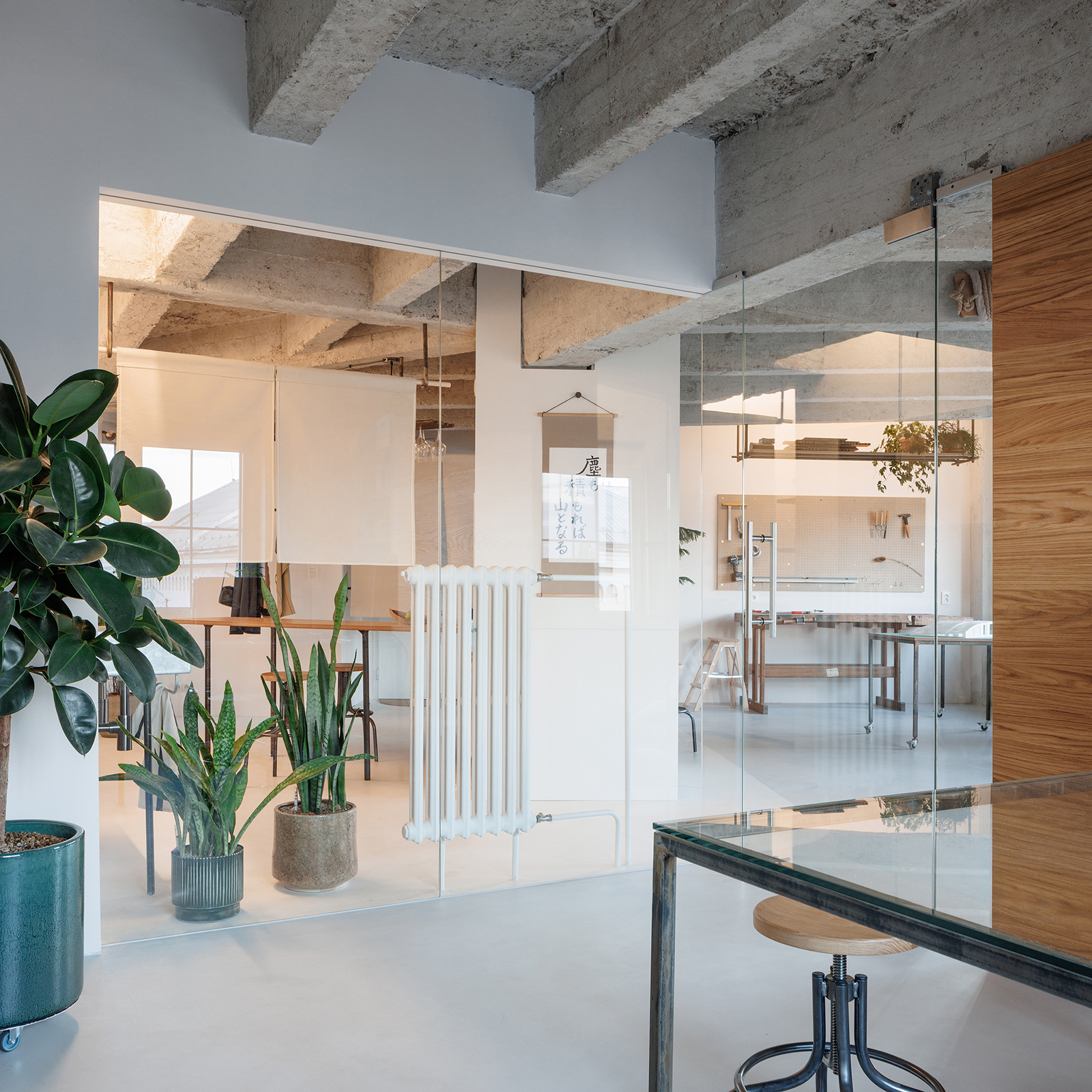
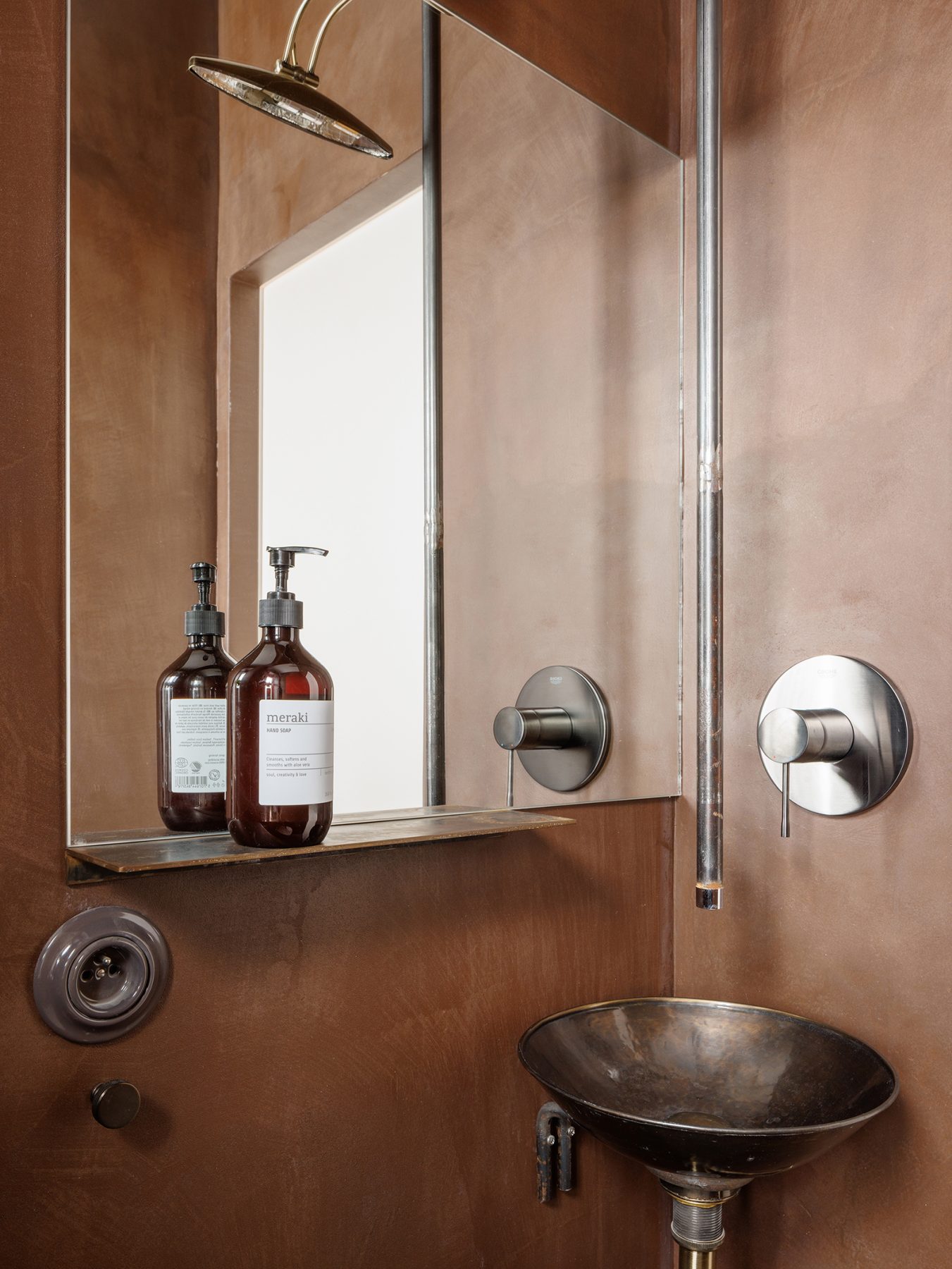
A former gas pipe, no longer in use, is transformed into a faucet descending from the ceiling—an unexpected gesture that blurs the boundary between infrastructure and design. Three enclosed rooms are set apart from the open plan: a storage room, a toilet, and a private office. A glass partition separates and, also, connects the office with the rest of the space. Thanks to it, the continuity of the beams remains legible throughout the interior.
Similarly, raw painter’s canvases replace solid partitions, acting as soft, adjustable boundaries that can be removed or repositioned. Plants on wheels function as living partitions, introducing a temporal and organic dimension to the interior.
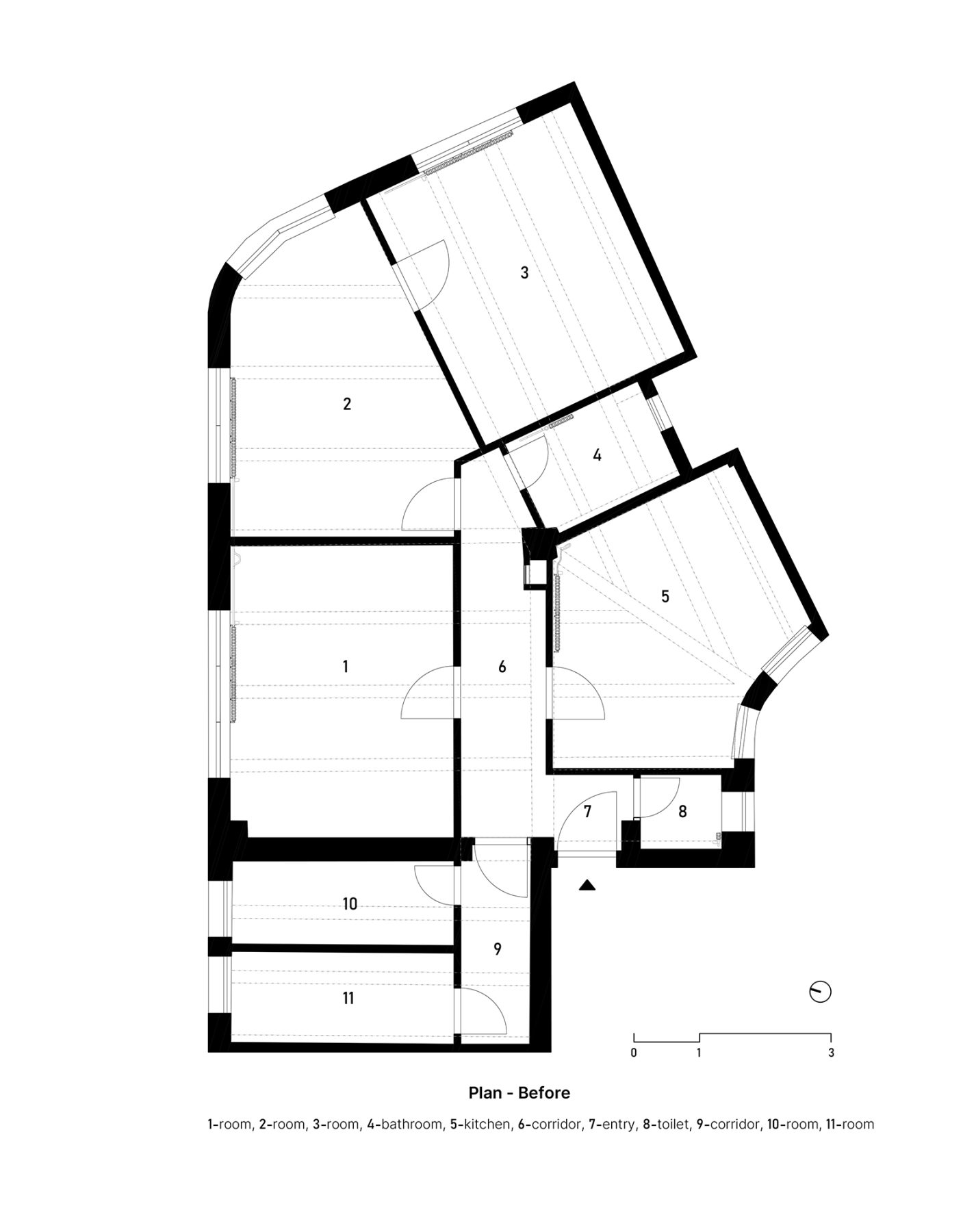
What do we expect from the spaces we move through every day, based on our past experiences?
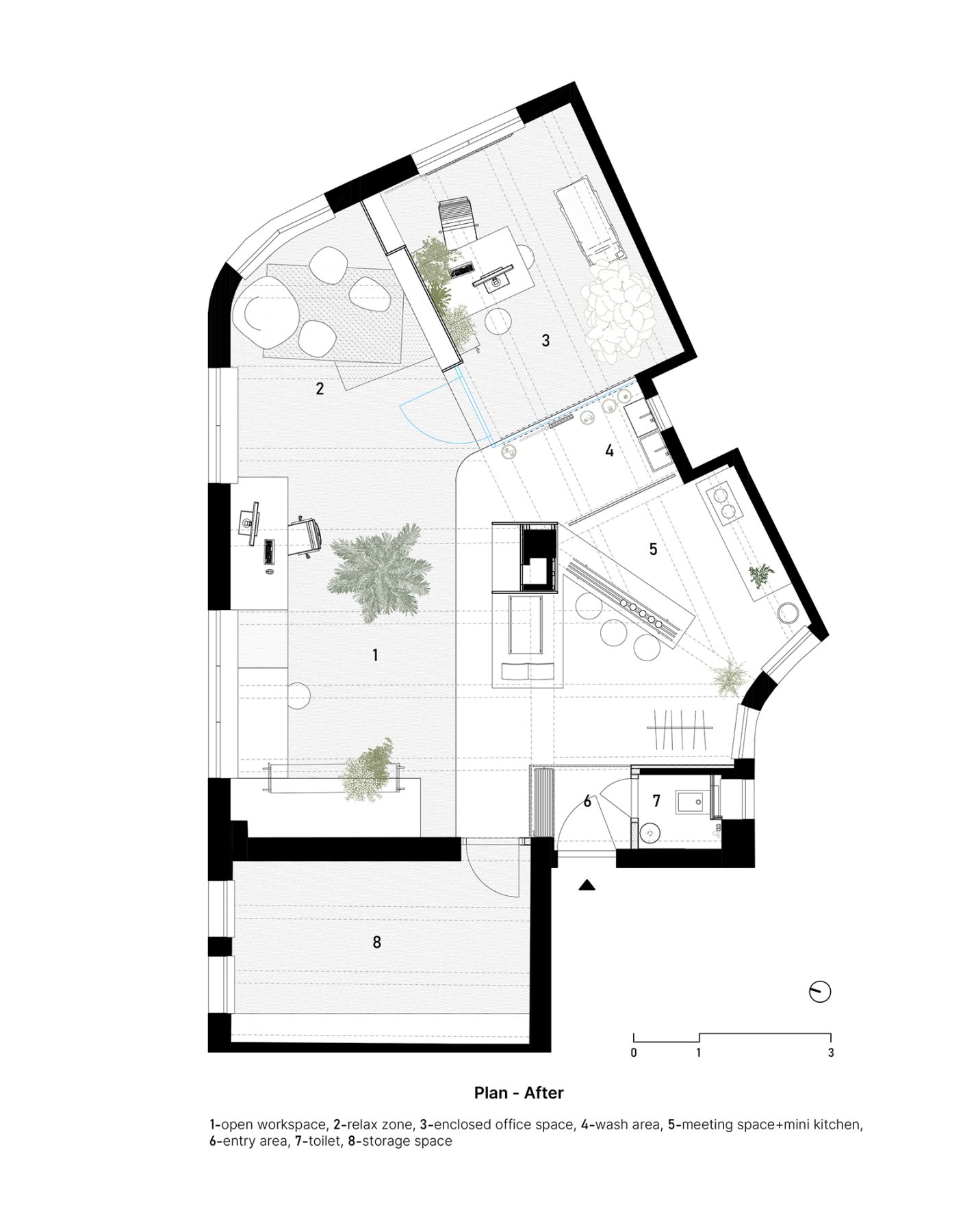
The studio remains in flux—adaptable, open, and continuously evolving. It is not conceived as a finished object, but as a spatial framework that accommodates change.
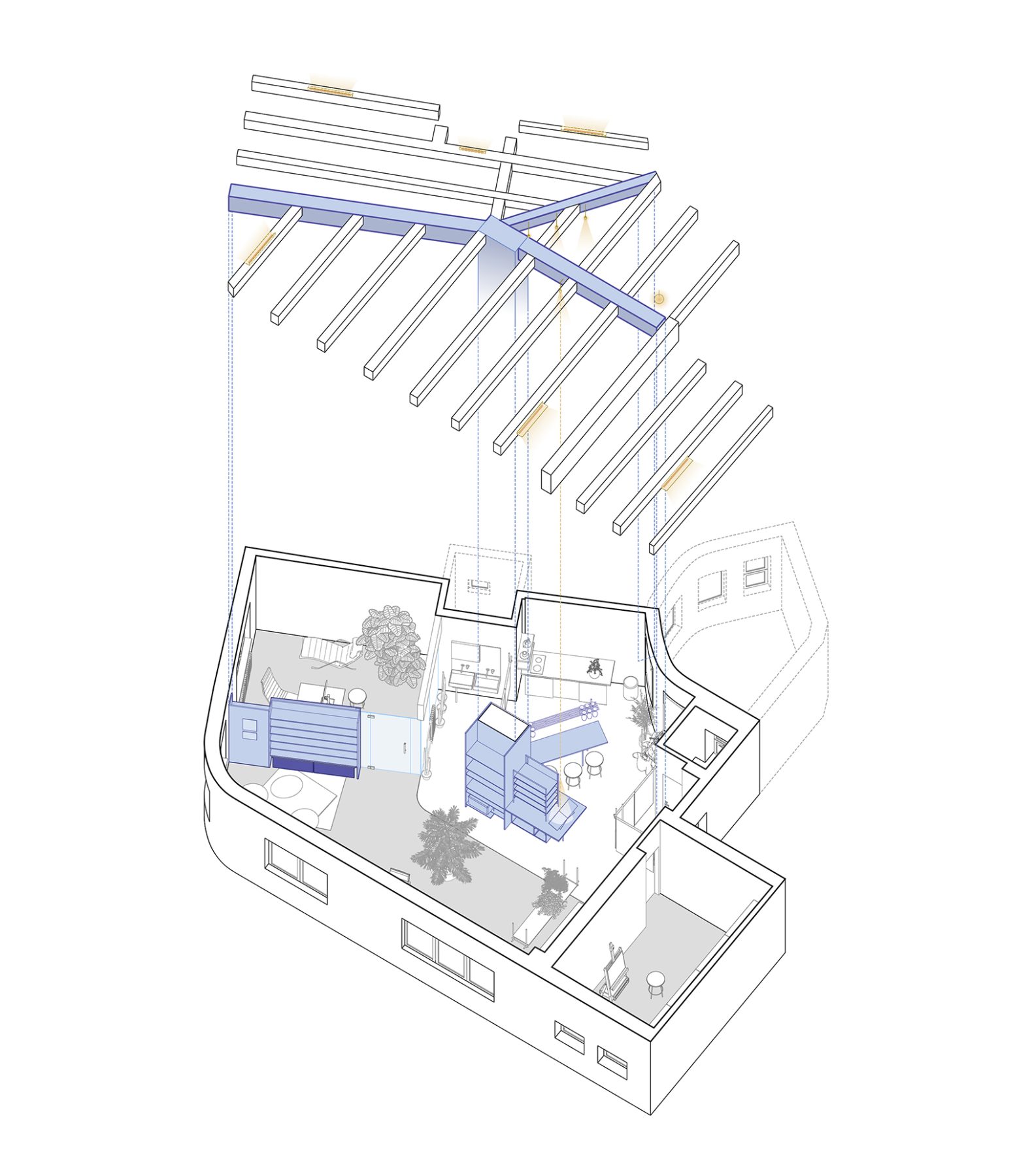
“If we wanted to set a new precedent for ourselves, what would we change in the streets we walk through daily, in our workplaces, in our homes?”
In this sense, Alchitekt Studio operates as both laboratory and mirror: a space where Lizáková’s architectural thinking is not only articulated but enacted. Here, design is inseparable from making, and space becomes a medium through which memory, material, and everyday life converge.
Facts & Credits
Project title alchitekt studio
Typology The Architect’s Office, Workspace
Location Bratislava, Slovakia
Area 85.8m2
Architecture alchitekt by Andrea Lizáková
Furniture fabrication Dielňa Haus
Photography Matej Hakár