More With Less explores renovations that bring architectural charm to the space with intriguing as well as affordable design solutions.
In Biel-Bienne, Switzerland, Sara Gelibter Architecte renovates and extends Felsenburg House with a vertical “house on a house” roof addition. Prompted by structural roof damage, the project transforms the rural structure, engaging with the house’s layered history on a limited budget while establishing a collaborative relationship with the owners that allowed two non-architects to discover their own architectural sensibility. By rethinking the building’s silhouette, the new addition reshapes Felsenburg House into a recognizable landmark overlooking the village, while prioritising reuse and low-impact construction strategies.
Located above the old town of Biel-Bienne, Switzerland, Felsenburg House is the result of a renovation and vertical extension designed by Sara Gelibter Architecte for an artist couple. What began as a modest interior refurbishment evolved into a far more ambitious transformation after structural issues with the roof were discovered following the purchase of the property in 2020. The unexpected condition became the catalyst for a new architectural strategy, ultimately leading to the addition of a new floor conceived as a “house on a house” roof extension.

The project is shaped by the intersection of the building’s layered history, limited budget, and the clients’ openness to experimentation with low environmental impact solutions.

The structure traces its origins back to Biel’s rural past, initially built as a shed linked to the local wine industry before being adapted for metal galvanisation. Over the decades, the arrival of the railway and changing industrial needs triggered multiple expansions and alterations. By the late twentieth century, the building had undergone a series of fragmented interventions resulting in a compromised roof structure that remained undetected for more than forty years.

The renovation reinterprets the building through a vertical architectural gesture.

Regulatory analysis revealed the possibility of adding a floor, transforming the structural necessity of rebuilding the roof into an opportunity to rethink the building’s silhouette.

The new upper level increases the overall volume and introduces additional spaces for the clients’ artistic activities, while giving the house a distinctive architectural identity within the village.

The intervention relies on a prefabricated timber construction system, enabling the new structure to be assembled in a single day through a coordinated helicopter lift and on-site carpentry.

Material choices respond to both practical and environmental considerations.
Fibre cement panels, composed of recycled cement and wood fibres were selected for their acoustic performance, light weight, and ease of installation, helping shield the house from noise generated by the nearby railway. The façade strategy further reinforces this approach: openings on the railway side were closed, while the building opens toward views of the Alps.

A defining dimension of the project lies in the close collaboration with the owners, who actively participated in the design and construction process. Reuse and resourcefulness guided many of the construction decisions.

Elements from the existing kitchen were integrated into the new living spaces, while materials from a temporary protective structure built during the roof opening were later repurposed as insulation. Recovered timber was used to construct an exterior pergola and custom furniture, and wooden framing replaced metal supports for interior drywall structures.
The interior staircase offers a particularly symbolic gesture: salvaged from a theatre dismantled by the husband’s father, it coincidentally matched the building’s floor-to-floor height and now anchors the vertical circulation of the house.

Reflecting on the process, the architect emphasizes the collaborative spirit that shaped the project: “What I find most beautiful about this project is that it allowed two people, who are not architects, to discover a sensibility they likely didn’t even know they had.” Over four years of dialogue and shared decision-making, the design evolved organically through conversation and experimentation. “Solutions were never imposed; instead, they sprang up and evolved naturally.”
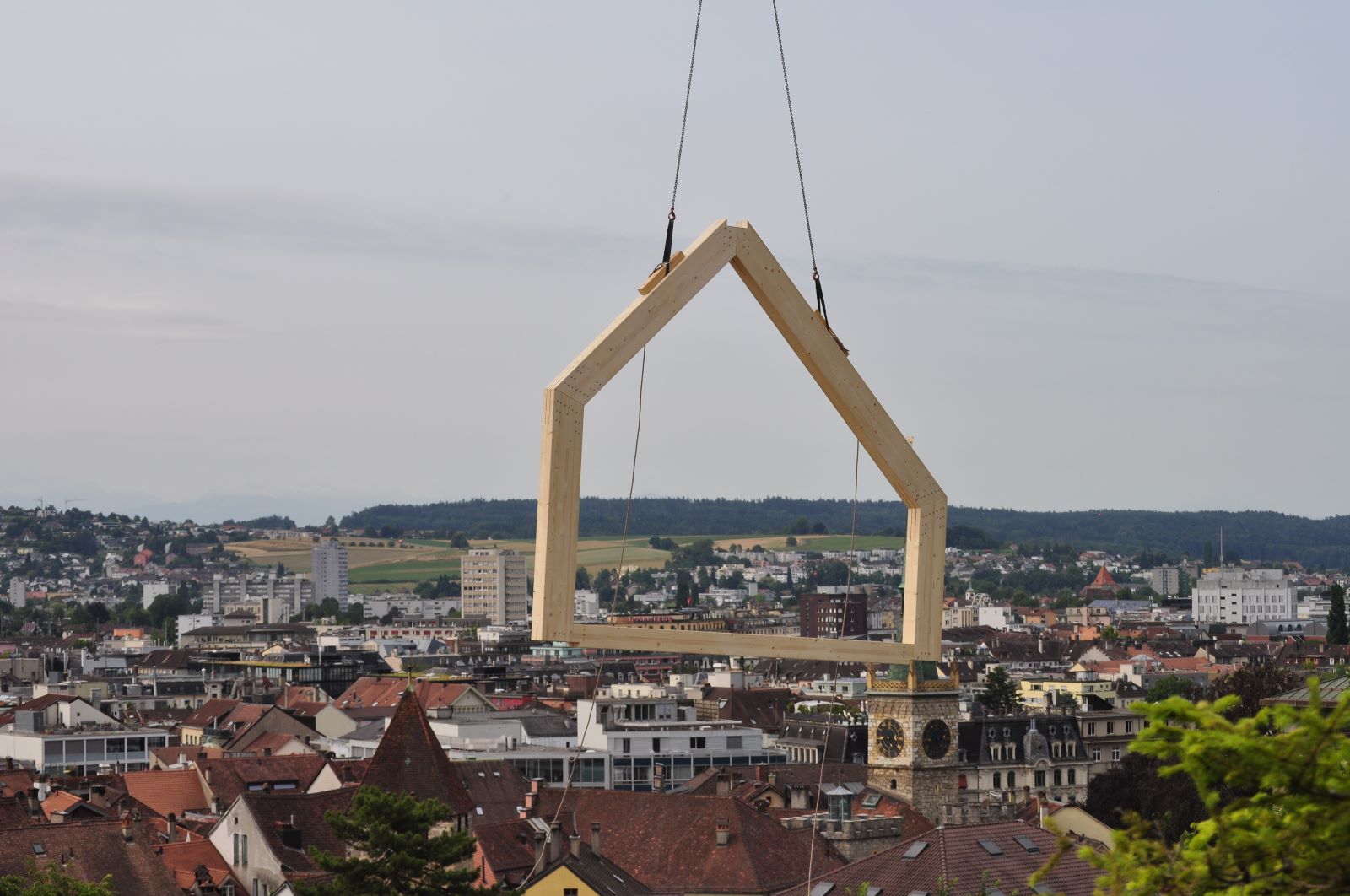
Ultimately, the project demonstrates how structural constraints, regulatory opportunities, and collaborative design can converge to generate a distinctive architectural response. The result is a carefully balanced transformation that restores the building’s structural integrity while reshaping it into a recognizable landmark overlooking Biel-Bienne.
Plans


Facts & Credits
Architecture: Sara Gelibter Architecte
Project title: EFH – Felsenburg House
Years of construction: 2020-2024
Project type: Private house and roof extension
Area: 280 m²
Team & Collaborators: R. Mantuano Sàrl, mason, Peseux | J.K-Char pente, carpenter, Brügg | Despont, sanitary installations, Biel/Bienne, Schmid und Pletscher AG, structural engineer, Nidau | Posarte, floor ing, Kerzers | Giampani, painting and plasterwork, Biel/Bienne | Major Toiture, roofing and sheet metal work, Biel/Bienne | Fasel, scaffolding, Neuchâtel
Photography: Cyril Käppeli